


CITY OF LONDON (ROMAN WALL) FINSBURY BARBICAN REGENT’S CANAL CANONBURY


Gresham St.
ST.ANNE and ST.AGNES Church
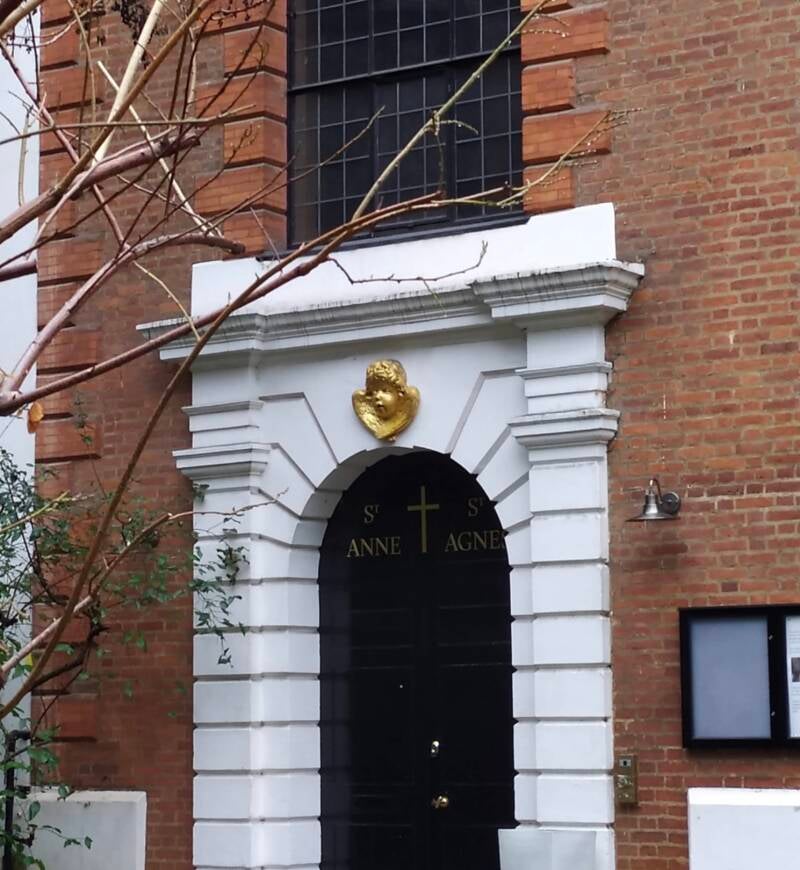

This stunning Anglican Church is the home of the musical charity the VOCES8 Foundation. The VOCES8 Centre (formerly known as the Gresham Centre) at the church of St Anne & St Agnes is designated a Chapel of Ease to St Vedast alias Foster in nearby Foster Lane. Although there are no regular Sunday services, the church is sometimes open to visitors
https://voces8.foundation/the-voces8-centre-at-st-anne-st-agnes-churchC
Noble St.
Remains of ROMAN WALL (FORT)

The Fort was a 12-acre military garrison established around AD 110-120 in the north-west corner of Roman London (Londinium). It was a major, square-shaped, stone-walled fortification housing up to 1,000 soldiers that influenced the city's later layout.
WILLIAM SHAKESPEARE lived here

The fact that William Shakespeare was a lodger of the Montjoy (or Mountjoy) family was discovered in 1909 by the American researchers Charles William Wallace and his wife, Hulda Berggren Wallace.
While examining neglected documents in the Public Record Office in London (now The National Archives), the Wallaces found the legal papers for the lawsuit Bellott v. Mountjoy.
The documents included a deposition signed by Shakespeare on May 11, 1612, which revealed that he had lived in the house of Christopher and Marie Mountjoy, French Huguenot immigrants, on the corner of Monkwell and Silver Streets in Cripplegate, London, around 1604.
This discovery is very significant: it provided the only known specific London address where Shakespeare lived, as well as one of only six known surviving signatures of the playwright.
The discovery was later popularized and detailed by researcher Charles Nicholl in his 2007 book, The Lodger: Shakespeare on Silver Street.
Site of ST.OLAVE SILVER ST. Church
PLASTERERS HALL

Today, it maintains a connection with the trade by establishing plastering standards and by officially accrediting plasterers. The company is also a charitable and educational institution and generates income by renting out the hall on a private hire basis for events.
London Wall (street)
This stretch was created after WW2
Remains of Roman Wall (Fort) Bastion inside carpark
BARBER-SURGEONS HALL
Barber-surgeons were common medieval medical practitioners who combined haircare with, or instead of, specialized physicians to perform surgeries like bloodletting, teeth extraction, setting bones, and amputations. Originating around 1000 AD, they formed official guilds, such as the Company of Barber-Surgeons in London (1540), before eventually separating into distinct, respected surgical professions by 1745.
Wood St.
The street was originally the main north–south route through the Roman Fort, which was discovered after World War IIbombing. The north gate of the fort became Cripplegate, the south gate of the fort was just south of the junction with Love Lane, and the road diverts slightly to the east suggesting that the gate was blocked up or in use, and they had to knock through the Roman fort wall to allow Wood Street to continue.
It has been suggested that this was an early road after the so-called Alfredian restoration of the City in around 886 AD.
The road led from the main port at Queenhithe (Bread Street) to the main market street at Cheapside and then on north to Cripplegate and out of London to the north.
Site of CRIPPLEGATE
It has been suggested that 5hat it takes its name from the Anglo-Saxon word crepel, meaning a covered or underground passageway.
Another unsubstantiated theory suggests it is named after the cripples who used to beg there.[5] The name of the nearby medieval church of St Giles-without-Cripplegate lends credence to this suggestion as Saint Giles is the patron saint of cripples and lepers.
Cripplegate was originally the northern entrance to the Roman fort, built c.AD120. This Roman gate probably remained in use until at least the late Saxon period when it is mentioned in 10th and 11th century documents. The gate was rebuilt in the 1490's. Throughout its history Cripplegate had a variety of uses. It was leased as accommodation and also, like the more famous Newgate, used as a prison.
After the restoration of Charles II in 1660 all of the City gates were unhinged and the portcullises wedged open making ceremonial entrances before being demolished.
Cripplegate gave access to a substantial medieval suburb and of the village of Islington. Extra defensive works outside the gate gave rise to the name Barbican which was subsequently taken as the name for the post-WW2 rebuilding of the area.
The information above comes from an information board about the London Wall, at the Cripplegate site.
The BARBICAN

Throughout most of London’s history the area now occupied by the Barbican was very poor. It was predominantly encompassed by the ward of ‘Cripplegate Without’. This was, as the name suggests, the ward just outside Cripplegate, one of the city gates.
Right up until World War Two the area was a dense network of roads and housing and was traditionally the centre of the rag trade: fabric merchants, dress makers and tailoring.
The Barbican was built after the Blitz left this area flattened and soaked in chemicals
In the 1950s, three architects, Geoffrey Powell, Christoph Bon and Peter Chamberlin, known together as ‘CPB’, were employed to design a brand new estate for the area of around 16 hectares (27 football pitches).
They were young, idealistic and had cut their teeth designing the Golden Lane Estate next door. Inspired by the modernist architect Le Corbusier (1887-1965), they wanted to create something radical, visionary and for it to be an awe-inspiring symbol of London rising out of the ashes.
The practice was founded in 1952 by Geoffry Powell (1920–1999), Peter "Joe" Chamberlin (1919–1978) and Christoph Bon (1921–1999),[1] following Powell's win in the 1951 architectural competition for the Golden Lane Estate. The three founding partners taught at Kingston Polytechnic (now Kingston UniversitySchool of Architecture) when they each entered the design competition with the agreement that should any of them win they would form a partnership with the other two to deliver the project.
The architects tried to create something bold, new, and human-focused: a ‘city within a city,’ a place to live, learn, eat, socialise, and listen to music without needing to step outside. This was a stark contrast to the cramped Victorian terraces that once stood there.
Barbican, a fortress?
The "half-moon" shapes and architectural details (Look for the sort of slits used by medieval archers …) are nods to the Roman watchtower (barbecana) that once stood there.
The site includes remnants of the original Roman City wall.
BRUTALISM
A distinctive tooled-concrete finish, incredibly labour intensive. After the concrete had dried for at least 21 days, workers used handheld pick-hammers or wider bush-hammers to tool the surface and expose the coarse granite aggregate
Residential
The Barbican estate was always intended as a commercial venture to make money for the City. What sort of residents were the Barbican flats originally pitched at? The City asked the architects to design residential accommodation to meet “a demand among middle and higher income groups employed in the City”.
With that in mind, the flats were marketed for rent on five year terms at full market rent.
If anyone moans that their underfloor heating isn’t enough to heat their flats, the answer is that this is exactly how it is meant to be. It was only intended to be background warmth, and it was always intended that people should have their own conventional electric fires or radiators to boost it as necessary. (Many people ask the Estate Office to turn their background heating down, particularly in the bedrooms.)
Your only option for cooking is electric. There’s no gas. But actually, Chamberlin Powell and Bon recommended that all kitchens should be provided with gas as well as electricity. The City Corporation didn’t want to do that.
Around 4,000 people live on the Barbican estate and every now and then you get a glimpse of their decor.
RESIDENTS’ ONLY GARDENS
The estate contains two gardens for the use of residents only. This is the Thomas More Garden as seen from the Thomas More highwalk.
Only kitchen taps provide drinkable water; bathroom taps use water from separate, massive rooftop tanks.
ENERGY CENTRE
A hidden, vast plant room (roughly one-third the size of Wembley Stadium) powers the complex with giant boilers and pipes.
BEECH GARDENS
Beech Gardens (on the highwalk over the Beech Street ‘tunnel’) were designed by Nigel Dunnett and on his website there is a terrific description of how he achieved the transformation of the area.
Arts Centre


Chamberlin Powell and Bon invented the idea of the Barbican Arts Centre in a report on the potential for development in the Barbican area which they wrote in 1955. Their ambition was limited to it being “a concert hall, theatre or cinema”. It grew from there to become one the largest art centres in Europe
LSO
MONDAYS £7: https://www.barbican.org.uk/whats-on/cinema
Plus two schools and a library.
Free events
CONSERVATORY
The second biggest conservatory in London after Kew is one of the Barbican’s best kept secrets. It is usually open on Sundays, but is sometimes shut for private events, so if you are thinking of visiting it is best to consult the website first.
More quirky things
One art gallery entrance door has only ever opened once - in 1981 - but they can’t remove the ‘entry’ sign because it’s protected.
A planned sculpture courtyard - still called the Sculpture Court - never materialised because the courtyard is actually the roof of a theatre below.
The Barbican is London’s largest labyrinth
A 500-year-old Mendelssohn tree stump is found on the estate.
Quirky London Underground tunnels under the Barbican

ST.GILES CRIPPLEGATE Church
Do not miss the saints in the stained glass windows, particularly St Margaret Thatcher in the window in the end nearest the Girl’s School.
St.Alfege’s Gardens


Remains of the city wall
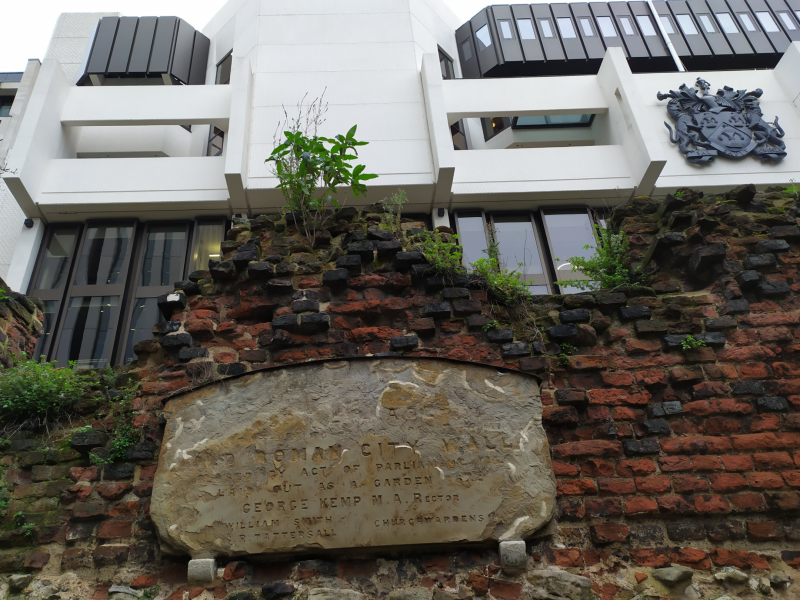

Remains (tower)of ST. MARY’s ELSYNG “SPITAL”


A London merchant, William Elsyng, founded the hospital in 1330 to provide shelter, spiritual and physical care for London's homeless blind people. It was possibly more like an alms-house than a modern hospital, providing a permanent home for poor people who could not look after themselves.
William Elsyng died in the Black Death, in 1349, and was buried in the church.
Elsyng's hospital remained part of an Augustinian priory until it was closed in 1536. Most of the hospital buildings were then made into a private house which, in 1541, belonged to the Master of the King's Jewels.
1630 - The site is sold and it becomes home to Sion College
1666 - The site is damaged in the Great Fire of London
1777 - St Alphage's parishioners bought the church to replace their own which was derelict.
SALTERS HALL

The Salters' Company was first granted a Royal Charter of Incorporation in 1394, with further charters authorising the Company to set standards regulating salt industry products from the City of London. The formal name under which it is incorporated is The Master, Wardens and Commonality of the Art or Mystery of the Salters of London.
The Company was originally responsible for the regulation of salt merchants, but began losing control over the trade as the population of London increased and spread outwards. Until the 19th century, the main use for salt was to preserve food for the winter months. Salt was probably the first traded commodity which if not available locally was imported.
Through careful stewardship of financial bequests and funds, the Company now serves as a significant educational and charitable institution whilst maintaining links with its heritage by supporting education in chemistry, for example by awarding scholarships to chemistry and science students,
Fore St.
Moor Lane
Silk St.
BARBICAN CENTRE entrance

Nearby
Chiswell St.
Former WHITBREAD BREWERY
MOORGATE (STREET) and LONDON WALL (STREET)
MOORGATE LU Station
BARBICAN CINEMAS
CROMWELL TOWER
Welcome to Finsbury
Boggy ground, poorly drained, an area for grazing, archery practice, cloth drying .
Shakespeare mentions the area in HENRY IV.
Once drained, as a remote place, was the site of the PLAGUE HOSPITAL and a refuge for Londoners displaced by the Great Fire.
Golden Lane
BANKSY. Homage to BASQUIAT
Former CRIPPLEGATE INSTITUTE (then GOLDEN LANE THEATRE) and LIBRARY
It provided a of range educational and cultural services to the residents and workers of the area.
WEB ABOUT THE WHOLE AREA WITH POST-WAR PHOTOS: https://alondoninheritance.com/thebombedcity/cripplegate-institute-jewin-crescent/

Nearby
WELSH PRESBYTERIAN Church
This building is the Mother Church of the Welsh Presbyterian Church in London, whose history is:
c.1774, a Welsh Calvinistic Methodist congregation held services in Cock Lane, Smithfield. By 1785 they had moved to Wilderness Row, near the junction of what is today St John Street and Clerkenwell Road. In 1822-3 they moved to Jewin Crescent, a street now lost under the Barbican but maps at Londonist make it clear where this was. Wales online has a splendid photo of the congregation gathered outside this chapel in 1876, presumably, a farewell gathering.
1878-9 a new chapel was built by Charles Bell in nearby Fann Street and the congregation moved there but retained the Jewin name.
The chapel was destroyed in WW2 air raids in September 1940. Capel Jewin has a painting, uncaptioned, which we think is probably the chapel ruin.
Replaced by current building in 1956-61, designed by Caroe and Partners in a Swedish-inspired form of modern architecture sometimes called the New Humanism.
And the French?. They were based nearby
Huguenot fan makers settled here and the Worshipful Company of Fanmakers met in their Common Hall nearby and adopted their new constitution in the year 1710.
THE FRENCH HOSPITAL WAS CLOSE: https://en.wikipedia.org/wiki/French_Hospital_(La_Providence)

Possible Diversion to CHARTERHOUSE and CLERKENWELL

Nearby
Fortune St.
Site of the FORTUNE PLAYHOUSE
Whitecross St.
Shops, eateries and street-food market

Alternative route to Islington: Diversion towards BUNHILL FIELDS and WESLEY’S CHAPEL: see next chapter

Along Golden St.
Garrett St.
Former WHITBREAD BREWERY stables
Over Old St.
OLD STREET, an ancient thoroughfare
Old Street was recorded as Ealdestrate in about 1200, and le Oldestrete in 1373. As befits its name there are some suggestions that the road is of ancient origin. It lies on the route of an old Roman or possibly pre-Roman track connecting Silchester and Colchester, skirting round the walls of Londinium, today the areas known as the City of London.
The western part was widened between 1872 and 1877, but it narrows east of Coronet Street; there survive, at No.s. 340-342 on the south side of the street and No.s. 323 and 325-329 on the north side, some domestic buildings from the eighteenth and early nineteenth century, though somewhat battered and altered in function.
Old Street and the surrounding areas of Hoxton Square and Great Eastern Street host a thriving night life. The street and its adjacent areas have attracted IT and tech companies, both established and start-ups, and Old Street Roundabout, located at the junction with City Road, has been dubbed Silicon Roundabout.
THIS SITE COVERS THE AREA, STREET BY STREET!: https://everystreetinlondon.com/2016/04/05/day-22-part-1-finsbury-city-road-old-street/

Detour
Former ST.LUKE’s OLD STREET Church, now a concert hall

designed by John James and Nicholas Hawksmoor, under the Commission for Building Fifty New Churches, an attempt to meet the religious needs of London's burgeoning 18th-century population. It served as a parish church from 1733 to 1959.
Following closure in 1959, the church stood derelict and roofless for some 40 years, but since 2003 has been a music centre operated by the London Symphony Orchestra and known as LSO St Luke's. It is the home of the LSO's community and music education programme, LSO Discovery.
James is thought to have been responsible for the body of the church, and Hawksmoor for the west tower, the flanking staircase wings, and the obelisk spire (a most unusual feature for an Anglican church).[4][5] The spire was topped by an unusual weather vane depicting the head of a dragon with a fiery comet-like tail: this was misinterpreted locally as a louse, and by the mid-20th century had gained the church the nickname "lousy St Luke's"
The effects of the subsidence remain visible in the distorted shapes of the windows on the north side of the building. The church stood on often waterlogged ground near the (historically) notoriously marshy Moorfields area,I
Conservation Area


IRONMONGER ROW BATHS
The first, a public wash house and slipper baths,[1] opened in 1931. The second phase, comprising the main swimming pool, the children's pool, and Victorian-style Turkish baths, opened in 1938.
From just after the Second World War until the new complex at Crystal Palace was built in the late 1960s, the baths were the home of the world-famous Highgate Diving Club, who held their club night there every Friday and also met during the public sessions on Saturday mornings. The Olympic diver, Brian Phelps(winner of the bronze medal for highboard diving in the 1960 Olympics) trained there regularly with his coach, Wally Orner, as did many of the club's international and Olympic divers, such as John Chandler, John Cooze, John Miles, Billy Wood, and Alun Roberts.
The facility operates numerous programs, including a branch of the Tom Daley Diving Academy.
Central St.
ENERGY CENTRE 1
The Islington Council BUNHILL HEAT & POWER NETWORK
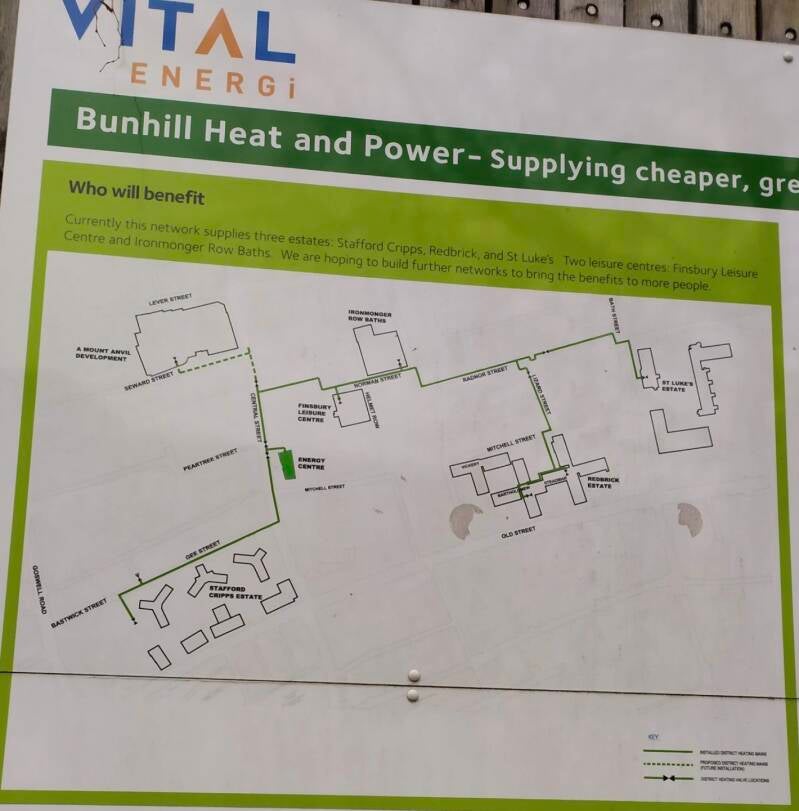
A Combined Power and Heat engine, powered by gas: it uses heat (waste heat: normal electricity production wastes up to 2/3 of the fuel used to make it) created by producing energy to heat buildings and provide hot water.
From 2012 the system benefited 800 homes (estates, separate buildings, leisure centres) and this encouraged the ISLINGTON COUNCIL to extend the network to additional 550 properties (KING SQUARE and MORELAND PRIMARY SCHOOL, rebuilt).
And tenants receive a 10% discount on heating charges. Tonnes of carbon emissions are lower.
The ENERGY CENTRE and pipe distribution network was constructed thanks to the partnering with TFL, who was upgrading the UNDERGROUND vent shaft (MORELAND + CENTRAL Streets) to provide additional heat from the tube. The new ENERGY CENTRE is on that site. If one of the ENERGY CENTRES fails, the other one takes over (plus communal boilers in each estate provide further resilience). There is spare capacity to supply more buildings.

Vent shafts carry hot air from the LU (from trains and other machinery) to ground level in order to help control the temperature inside. The hot air is pushed through a HEAT PUMP, which captures it via a closed loop water circuit. This is used to heat a gas which is then put through a compressor which converts it into a VERY HOT LIQUID, making the pipes (in a very well insulated system)that hot that heat the water (heating for buildings).
Taking advantage of the properties of a refrigerant gas the hit liquid in the heat pump passes through the water in the pipes and in doing so turns back into gas. The heat pump is then ready to be warmed up again by more warm air from the tube.
And in the summer the fan in the ventilation shaft can be reversed to provide cooling to the UNDERGROUND ETWORK.

The BHPN is the first in the world to take heat from a metro network and use it to provide greener, cheaper heat to the city. As a means to harness a wide range of renewable and waste sources, it has a huge potential, as a reducer of carbon emissions and heating bills. Self sufficiency and environmentally sound.
Islington has reduced carbon emissions, 2005-2020, a 40%. It is working to becoming NET ZERO carbon by 2030 (MAYOR OF LONDON strategy)
And residents are helped out of fuel poverty
Heat. Etworks work well in densely populated areas, where heat has to travel less thence the loss is reduced..
The WASTE HEAT from data centres could be equally harnessed.
ISLINGTON and TFL are carrying out further research to identify opportunities for similar projects across the network.
Program CELSIUS is a EU funded project, extended to various cities. In London the MAYOR funded an early feasibility work, by RAMBOLL ENGINEERS), coordinating London’s involvement in CELSIUS.
Memorial to Policeman ALFRED SMITH (1917 air raid)

An old entrance to a modern buildin*?

King’s Square
St.CLEMENT’s Church
On completion of this church, ST.BARNABAS KING SW (here), ST.CLEMENT’s LEVER ST. and ST.MATHEW’s. CITY ROAD, we’re united, and the church became ST.CLEMENT’s FINSBURY.
The land had been purchased from BART’S HOSPITAL, 1822.
Together with the church the land was built up as a garden square of middle class villas.
Designed byTHOMAS HARDWICK, Ionic Greek and slender secular Gothic, it was built by French PoW. Chapel of ease of St.Luke. Parish in1846.
Damaged during the BLITZ. Grand interior reordered and furniture brought from other churches
ENERGY CENTRE 2.


FOUNTAIN and CATTLE TROUGH


Nearby, new developments
“OPENING THE LOCK GATE”, artwork

Over City Road
CITY ROAD, a drovers road
The New Road, London's first bypass, was a toll road built across fields around the northern boundaries of London, the first part of which opened in 1756. The route comprises the modern-day A501, that Old Marylebone Road, Marylebone Road, Euston Road, and Pentonville Road.
City Road, and Moorgate are the eastern parts
In 1755 influential residents of St Marylebone, Paddington and Islington, all separate villages close to London, petitioned Parliament for the right to provide a turnpike trust road by-passing the northern boundaries of the built up area of London. The road was intended initially as a drovers' road, a route along which to drive cattle and sheep, to the live meat market at Smithfield from roads approaching London from the north and north-west, thus avoiding the congested east–west route via Oxford Street and HIGH HOLBORN.
Originally, a very large road with compulsory long gardens in front of the terraced houses. Which facilitated the excavation of the FIRST UNDERGROUND!.
City Garden Row

Graham St.
CITY ROAD BASIN
Once the Regent’s Canal was in operation this basin would£ become more convenient than Paddington, in order to distribute goods into London, thanks to its proximity to the built up areas.
The area became the new centre of operations for companies like PICKFORDS.
The WENLOCK BASIN would be build soon afterwards.
GRAHAM ST. PARK, site of an industrial estate


BRITISH DRUG HOUSES

Founded in 1908 by older (18th c.)established firms of manufacturing chemists and druggists as a wholesaler for private chemists. New works established here. With WW1 it e landed into fine and laboratory chemicals no longer available from Germany.
Expanded overseas (Can., Aus.)after the war.
1926.Introduced very pure ether for anaesthetics and insulin.
Pioneer in vitamin production and therapies. Vitamin mix introduced. Artificial Vit.D. Synthetic crystalline. Process for obtaining Vit.A pure patented. Vit. A and D in RADIOSTOLEUM.
Development and production do PENICILLIN.
Later on laboratory reagents and chemicals, became main business.
Joint Ventura with GLAXO.
Acquired by MERCK.
De dlopent of neumáticos liquid crystals for electro-optic displays, ecoming one of the leading suppliers.
BDH retained as brand, but consolidated as MERCK
Islington Boat Club founded here

DIESPEKER WHARF, former terrazzo factory

The story goes that, in 1881, Italian entrepreneur LUIGI ODORICO sent a sales representative to London. Sigmund DIESPEKER came in the company of a craftsman, GIOVANNI MARIUTTO, to research the local terrazzo and mosaic market… But, instead of reporting back, they started their own company, becoming the first to offer such a product in England, a a firce to be reckoned with. Marble, granite and other mate were added to the catalogue.
Among the leading names among the Friulian and Venetian MOSAIC artists working in England are MAZZIOLI and FACHINA. The first came from Paris. The second, later, established his own business.
In the 1920s, in London, here’s reinforced precast terrazzo was devised, becoming a popular versatile commercial material. JOHN OUTRAM used 2 tons of precast fins for the concert columns of his temple-like storm water pump station in the ISLE OF DOGS.
Terrazzo

Around this stretch of the canal… the ANGEL CANAL FESTIVAL
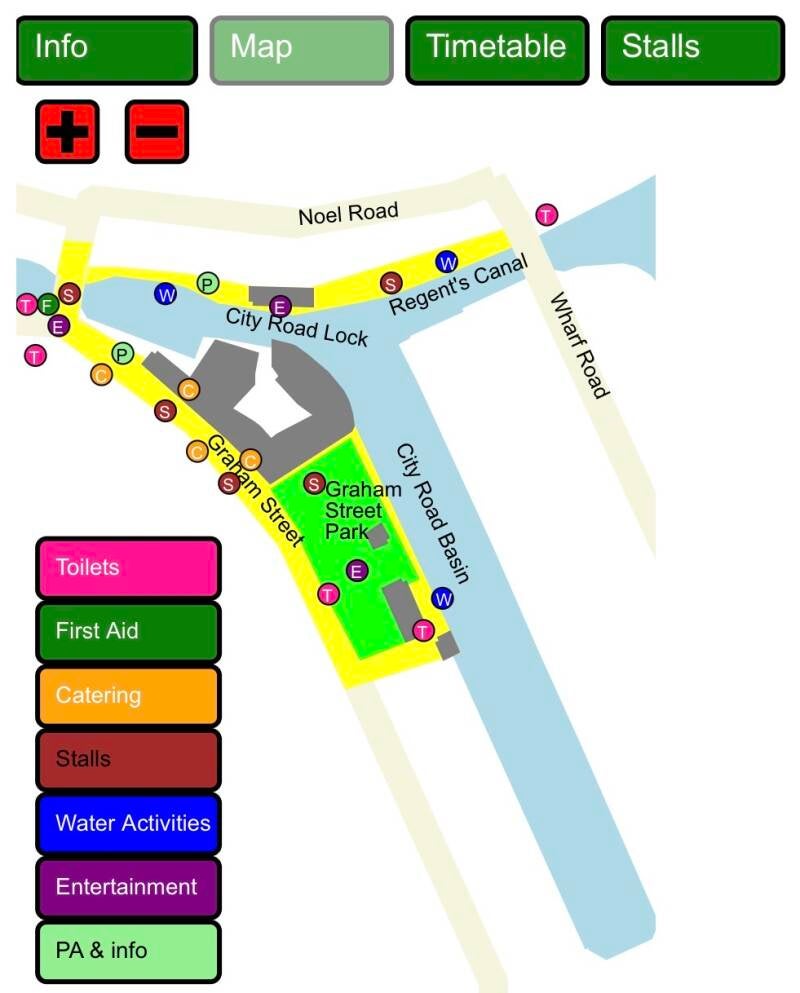
The REGENT’s CANAL
Dug out to the N of the NEW ROAD, thanks to the will of industrialists wanting to link the North of England canal system with the capital and, eventually, with its port. The Grand Union had reached Paddington in 1801. Planning went ahead (1811) but the canal construction limped to the DOCKS [1821) due to crisis, war and a volcano eruption…
Once the canal was opened factories, basins and wharves, gasworks, builders and timber yards… lined the whole route
A chance meeting of CH.MUNRO, chairman of the RC COMPANY with the SOCIETY FOR LELIEVING THE MANUFACTURING POOR facilitate the discussion of raising government loans, under POOR EMPLOYMENT, in order to finance the project and reassuming the works.
The ISLINGTON TUNNEL
It took three years to build, from 1815 to 1818 and was dug by a band of navvies using explosives, wheelbarrows, horses and sheer physical strength.
There is no towpath through the tunnel and boaters' horses were walked over the top. The route they took now passes through housing estates, a market and the thriving business and leisure centre of Angel, Islington.
JAMES MORGAN. Probably born in Carmarthen, south Wales. Architect and engineer. Employed by John Nash. Worked on the layout of Regent's Park and on the construction of the Regent's Canal as Chief Engineer of the Regent's Canal Company. Designed and supervised first the Maida Hill and then this tunnel.Resigned as Chief Engineer in 1835 following a dispute with the committee. Designed the mechanism for the London Diorama
Navies?
'Navies' were the men who built the canals which were known as 'navigations'. They moved across the country as the construction progressed and so gained a colourful reputation that may, or may not, have been earned. The term 'navigators' was extended to the men who worked on the construction of the railways and then to any construction labourers.
THE PLAQUEMINE LOCK P.H.

At the turn of the twentieth century Jacob Hortenstein came to Plaquemine to build a Lock, which was to enable heavy cargoes of Louisiana timber (from the Schwing Lumber & Shingle Corporation), moss (Schwing Moss co), and later sugar cane and oil, to transfer safely from the Bayou onto the mighty Mississipi. Carrie B Schwing opened Plaquemine Lock in 1909, swooshing a champagne bottle against the lockhouse as the family steamer (also called Carrie B Schwing) passed through the lock gates.
Carrie B Schwing & Jacob Hortenstein’s great-grandson (Jacob Kenedy) opened Plaquemine Lock in London on the Regents Canal. It is a pub serving great beer, strong cocktails and wine for those inclined.
Vincent Terrace
Welcome to The Angel, Islington!
Colebrooke Row and Duncan Terrace


You can join other routes from here


Create Your Own Website With Webador