


HACKNEY-CLAPTON SQ. HACKNEY DOWNS STOKE NEWINGTON WOODBERRY WETLANDS CLISSOLD PARK NEWINGTON GREEN
Clapton Square
Clarence Place
Clarence Rd.
Downs Park Rd.
NEW TESTAMENT Church of God
Over Cricklefield Rd.
HACKNEY DOWNS (PARK)
Hackney Downs is a 16-hectare (40-acre) public park in East London, established in 1884 following intense local campaigns against the privatization of common grazing land, including a famous "land grab" riot in 1875.
During the 1860s and 1870s, the Downs were threatened by illegal enclosure. Intense pressure from the Commons Preservation Society and locals, culminating in a 25,000-person protest in 1875 where fences were destroyed, saved the land for public use. The land was formally recognized as a public park in 1884.
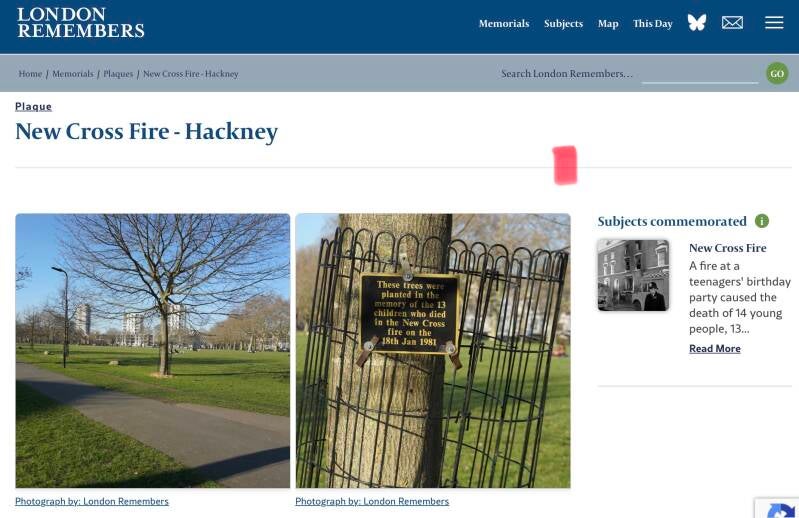
Memorial tree to the NEW CROSS FIRE VICTIMS
Queensdown Road
THE STAR BY HACKNEY DOWN P.H.

Welcome to Lower Clapton
The hamlet of Clapton was, from 1339 (when first recorded) until the 18th century normally rendered as Clopton, meaning the "farm on the hill". The Old English clop - "lump" or "hill" - presumably denoted the high ground which rises from the River Lea. Clapton grew up as a linear hamlet along the road subsequently known as Lower and Upper Clapton Road. As the area became urbanised, the extent of the area called Clapton eventually increased to encompass most of the north-eastern quarter of Hackney.
THE DOWNS BAPTIST Church


The church used to have a music society and once hosted the Fisk Jubilee Singers in 1873.
The Tennessee singers were a group of freed slaves who stopped in Hackney on a world-wide mission to raise funds for the first Black university in America after emancipation.
They famously fought to give all African Americans the right to an education.
The church stood against injustice again in 1994 when it gave refuge to the Ogunwobi family - Nigerian nationals threatened with deportation by the home office after living in Britain for more than a decade.
Downs Rd.
Former THE DOWNS HOTEL


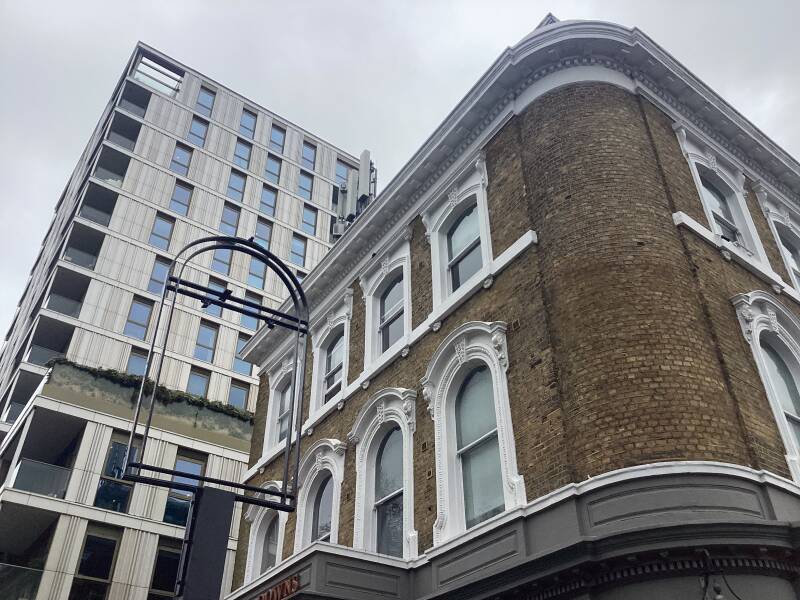
A PICKWICK BYCICLE CLUB?

The oldest surviving cycling club in the world was founded at Downs Hotel, during the craze for the newly evolving bicycle, just 2 weeks after Charles Dickens died. The founding members honoured him, as many other societies had done, by adopting the eponymous name from his first, and very successful novel, 'The Posthumous Papers of the Pickwick Club'.
From Timeline (2020 link dead): "... Well, in 1870 six Hackney men had taken their shiny new bicycles out to the country for a ride. That evening, they sat in The Downs Hotel. As they chatted on about this new craze, they decided they would start up a bicycle club. There was a long talk about what they should call their new club.
Suddenly someone came up with the idea "The Pickwick Bicycle Club": Charles Dickens, the author of The Pickwick Papers, had just died and people were feeling very sad about that, so all six of the men agreed on the new name. They made a rule that all the members of the club would have a nickname chosen from Charles Dickens’ book - and that the club uniform would be "simply a white straw hat with a black and amber ribbon".
The Club was a huge success - they went on rides out to the countryside every weekend, enjoying their cycling.
2022: Ian Visits, reporting on an exhibition at the Charles Dickens Museum, includes a photograph of the front cover of the Members Register of the Pickwick Bicycle Club, 1909 - 1926. This gives two addresses for their HQ: 9(?) Rathbone Place and 18 Eldon Street, suggesting that the club moved during the period that the register covers.

Over Rectory Rd.
Farleigh Road
Welcome to Shacklewell
Over Amhurst Road
Over Stoke Newington Road
Brighton Road
Nevill Rd.
Kynaston Road
Defoe Road

Over Stoke Newington Church St.


LO WEAVER LINE STOKE NEWINGTON STATION
Welcome to Stoke Newington
Church St.


Bouverie Rd.
Heathland Rd.
Fairholt Rd.
Bethune Road
Welcome to Manor House…or is it Woodberry Downs?
The area was originally known as Woodberry Down. However, the construction of the Seven Sisters Road and the consequent establishment of the Manor House Tavern gave rise to the alternative name Manor House Crossroads and with the arrival of the tube station in 1932, the area immediately around the tube station began to be known as Manor House. The demolition of the once very fashionable area of Woodberry Down and its replacement with one of London's biggest public housing estates resulted in 'Woodberry Down Estate' being used to refer to the public housing area and 'Manor House' for the area beyond. With the regeneration of the area during the early part of the 21st Century, the area is now being referred to once again by its nineteenth-century name of 'Woodberry Down'.
Large Victorian and Edwardian mansions are built with gardens backing onto the New River and overlooking the reservoirs. At this time Manor House and Woodberry Down become famous for suburban luxury; an early stockbroker belt.
From 1949 through to the 1970s much of the area was redeveloped, the old houses being demolished and replaced with a large council development known locally as Woodberry Down. The LCC compulsorily purchased the area for this purpose in 1934 in order to alleviate chronic housing shortages, but work did not begin till after the Second World War. Construction began in 1949 and the 57 blocks of flats were completed in 1962.
21rst CENTURY REGENERATION: https://hackney.gov.uk/woodberry-down
WOODBERRY WETLANDS
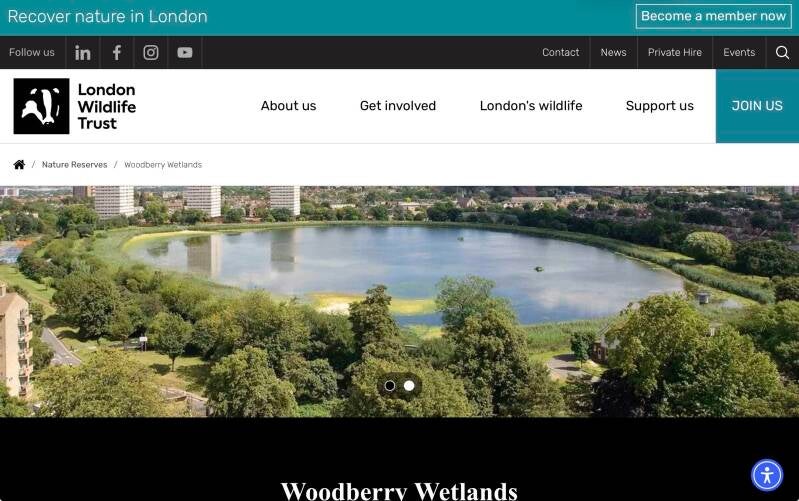
This is a nature reserve and designated Site of Metropolitan Importance on the site of the East Reservoir in the Manor House area in the London Borough of Hackney. The site opened to the public for the first time in 200 years on 1 May 2016. Covering 4.5 ha (11 acres) and situated close to the Lee Valley, Woodberry Wetlands was acquired as a nature reserve in 2014.
After a major redevelopment the East Reservoir now offers free public access. The reserve was developed by London Wildlife Trust, who runs the site.in collaboration with Thames Water, the company owning it, Berkeley Homes and London Borough of Hackney, with funding from Heritage Lottery Fund. The site contains a boardwalk, a visitors' centre with café, toilet facilities and a classroom. The New River Path runs alongside the northern edge of the reservoir. This forms part of a cycle route connecting to Walthamstow Wetlands, badged as the 'Wetlands to Wetlands Greenway

THE CASTLE

Over the last 30 years we have transformed the Castle from a dilapidated former Water Pumping Station into the Climbing Walls, Training facilities, Gym, Café, Shop and Garden you will find here today.
Green Lanes
CLISSOLD PARK and MANSION
The park is 22.57 hectares (55.8 acres) in extent. The main building within its boundaries is the Grade II listedClissold House, run as a cafe and events venue.
The park's facilities include children's playgrounds, sports fields, a bowling green, a skatepark bowl, tennis courts, and a paddling pool. Other attractions include an aviary with assorted captive species, an enclosure of deer and goats, a butterfly dome, and two small lakes hosting wild ducks, geese, swans and other water birds. The park also comprises a short section of the New River
The house
Formerly Paradise House), was built, in the latter half of the 18th century, for Jonathan Hoare,[3] a City of London merchant, Quaker, philanthropist and anti-slavery campaigner. (His brother, Samuel, half-brother of Sir Joseph Hoare Bt, was one of the founders of the Society for Effecting the Abolition of the Slave Trade.)
Hoare, in financial difficulties, mortgaged the estate, and then lost it by foreclosure to a Robert Pryor. It was sold by Pryor's executors to Thomas Gudgeon, a merchant, who owned it around the beginning of the 19th century.[6][7] Gudgeon sold it in 1811 to William Crawshay I.[8]
Subsequently, the estate passed, through a Crawshay family connection, to Augustus Clissold. When he died in 1882 the Ecclesiastical Commissioners bought the property, intending to profit from development. However, John Runtz and Joseph Beck persuaded the Metropolitan Board of Works to purchase it in 1887, to open it as a public park. The two lakes were named Beckmere and Runtzmere in their honour.
Back in Stoke Newington!

Highlights along Church St. W to E
Old ST.MARY’s Church
New ST.MARY’s Church
Former TOWN HALL
THE ROSE AND CROWN P.H.
PUBLIC LIBRART
ABNEY PARK CEMETERY
THE THREE CROWNS P.H.
From Clissold Park to Newington Green
Clissold Road
LEISURE CENTRE
Over Albion Road

Church Walk


I hope you are enjoying this guide!


Create Your Own Website With Webador