


HACKNEY CENTRAL RIDLEY ROAD MARKET NEWINGTON GREEN

Wilton
VIOLET CAFÉ
Fasset Sq.
EASTENDERS?
GERMAN HOSPITAL, now residential
This 1936 extension to Hackney’s German Hospital was built to accommodate an increasing demand for private beds by predominantly English in-patients in the post World War I period. As an addition to an existing range of buildings, Burnet, Tait and Lorne were freed from certain formal constraints, and the modernist design of the new wing was at the forefront of medical and architectural thinking of the time.
THE WHOLE HOSPITAL: https://ezitis.myzen.co.uk/german.html
Graham Road
MARIE LLOYD lived here

Clifton Grove
SISTERS’ HOME of the GERMAN HOSPITAL (1912)
Opened with 12 beds in 1845. The local German community was very large at this time and nurses were recruited from Germany from the Kaiserworth Institute.
Florence Nightingale was so inspired by this place that she enrolled there in 1851. In WW2 concerns about potential German espionage meant that the nursing staff were all arrested and interned on the Isle of Man. Was subsumed into the NHS in 1948.
Stannard Rd.
GERMAN HOSPITAL


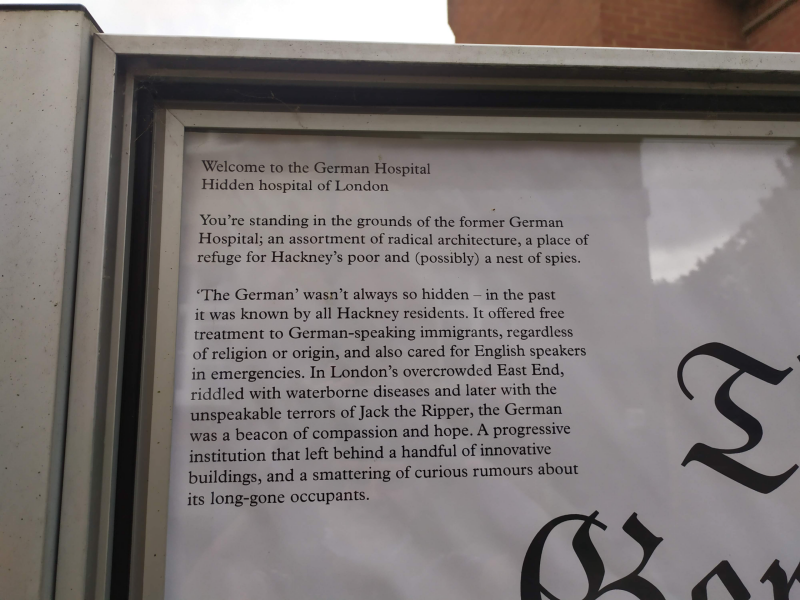
By 1850 the building of the North London railway track had progressed through the area; the cutting ran behind the Hospital, severing it from its garden. This no doubt stimulated the Governors to build new premises in the garden. The new building opened in 1864, and the Dalston Lane frontage was rented out.
Former HAMBURG LUTHERAN Church, now PENTECOSTAL
Built 1875-6 as the Hamburg Lutheran Church. Designed by E. Habershon and E. P .L. Brock in a German Gothic style as the church for the adjacent German Hospital. At the time the road was named Alma Road. This new church, consecrated on 13 July 1876, incorporated some of the furnishing of the old church including, apparently, a reredos attributed to Grinling Gibbons. Information from the Listing entry.
In 1982 the new Pentecostal Congregation bought the church and it is now known as the Faith Tabernacle Church of God.
Faith Tabernacle, a charter church of the United Holy Church of America, Inc. which is headquartered in Greensboro, North Carolina, has been a standard bearer of holiness with a Pentecostal message, an Apostolic order, and Episcopal structure.
A bit of history about Lutherans in London
The history of the German Lutheran Church in London began in earnest with many craftsmen from Hamburg coming here after the Great Fire of 1666 to help in the rebuilding. They were granted the site of the burned-out parish church of Holy Trinity the Less. Roque's 1746 map puts the Lutheran Church on the south-east corner of the junction of Little Trinity Lane and what is now Great Trinity Lane (see image).
Here a Lutheran church was built and opened in 1673. It served various nationalities in a variety of languages. Over the years other Lutheran churches were built and congregations formed, including two German chapels in the Savoy Palace, St Marys and (what would become) St Pauls; a Danish one in the Palace of St James, the Lutheran Court Chapel; and the Swedish Lutheran church in Swedenborg Square. Holy Trinity became known as the Hamburg Lutheran church, using only the German language.
Note: the St Pauls church was for the German Evangelical Reformed Church - see our St Pauls page for their story.
The 1714 arrival of Lutheran King George I (raised in Hanover) brought another influx of German Lutherans to London. And the fourth German Lutheran church was founded in 1763, St George's in Alie Street, Aldgate. A Lutheran group briefly occupied Hanbury Hallsometime between 1787 and about 1820.
The church on the City site of Holy Trinity survived until 1871 when it was closed and demolished as part of the development of the Mansion House station and the new Metropolitan line. The last service took place on 15 January 1871 and the congregation moved to the newly-built Dalston church.
In 1875-7 the building of the Embankment caused St Mary's to move to Cleveland Street. A German Lutheran church was built in Sydenham in 1876. Dietrich Bonhoeffer was pastor at Sydenham and at St Pauls. In 1902 the St James congregation moved to Montpelier Place and was renamed Christ Church.
Germans in London, and the two 20th World Wars
Both world wars made life for Germans living in London very difficult. In WW2 concerns about potential German espionage meant that the nursing staff were all arrested and interned on the Isle of Man.
In most cases the suspicions were unfounded but there was one self-declared Nazi: Pastor Schönberger of this Dalston church. In 1939 he returned (or was expelled) to Germany and the church closed. He was its last pastor. It is said that the church housed a radio transmitter larger than the BBC's. We are surprised how little information is available about him.
Ridley Rd.
MARKET
Goods, particularly fruit and vegetables, are sold from traditional barrows (trolleys) in the pedestrianised street from 8am to 6pm daily (not Sundays or bank holidays). There is a large range of traditional and exotic produce from around the world.
Many shops lining the street sell a wide variety of foods and household goods. New style stalls have recently been introduced by the local council.

Nearby
Former BIALA SYNAGOGUE
ST.MARK’s Church
Kingsland Road
”Ermine Street” a Roman road

Nearby, towards Dalston Rd. (S)
Ashwin St.
ARCOLA THEATRE
CAFÉ OTO
REEVE’s building. Workspace. Charity

Artists' colour manufacturer. Established by William Reeves (1739–1803). It has had a number of names, always including "Reeves" until ownership passed to Wilhelm Becker, through Colart Fine Art and Graphics, in 1991.
Grace's Guide gives the history and also provides our image from 1924.
The London Project associates the building with the early film industry, in 1907, possibly it provided materials that were used by film makers.
DALSTON PEACE MURAL
DALSTON EASTERN CURVE GARDEN


The route towards NEWINGTON GREEN continues on Northwards alongside Kingsland Road
Gillett Square
VORTEX JAZZ CLUB
Jude St.
THE RAILWAY TAVERN
(Mildmay Grove)


Church of ST.JUDE and ST.PAUL
The church was built in 1856 to
accommodate the expanding Mildmay population and the school opened in 1857.The church was
known for its missionary support; William Pennefather the vicar 1864-73 was a hymn writer and
renowned missionary speaker. He founded the Mildmay Conference and in 1870, built the Conference
Hall at Mildmay Park & . Seating 2,500, it was used for missionary conferences and as a highly
successful night school. He also established a hospital and missionary training school. The Vicarage
stands next to the church in Mildmay Grove North, although it is now privately owned.
Queen Margaret’s Grove
1963. This residential street was bombed during WW2.
Queen Margaret’s Court was completed as part of Islington’s post-war reconstruction in 1959.
ST.JUDE’s School and Cottages
WELCOME TO ISLINGTON!

Wolsey Rd.
In the 16th century the area had connections with the court of King Henry VIII (r. 1509–1547). The king used a house on the south side of the Green as a base for hunting the wild bulls, stags and wild boars that roamed the surrounding forest.
The area is marked by several streets taking their name from this period, such as King Henry's Walk, Boleyn Road (formerly Ann Boleyn's Walk), Wolsey Road and Queen Elizabeth's Walk.
1863) The corner pub (now flats) was called ‘The Lady Mildmay’ and is
listed in an 1863 Islington street directory. At the top of Wolsey Road, you will be opposite 122 Mildmay
Road. In the 1870’s this large house was Mildmay Cottage Hospital . It was replaced by the Memorial
Hospital at Newington Green.
Mildmay Road
MILDMAY
By 1611, what became known as the Mildmay estate was owned by the Halliday, or Holliday, family.[8] In 1673 ownership passed to Henry Mildmay, second son of Sir Henry Mildmay, who in turn was grandson of Sir Walter Mildmay, via the female line of the Halliday family owing to a lack of male heirs.[9]
Sir Walter Mildmay was the Chancellor of the Exchequer under Elizabeth I. He was one of the special commissioners in the trial of Mary, Queen of Scots, and founded Emmanuel College, Cambridge in 1584.
His grandson Sir Henry Mildmay served as MP and was Master of the Jewel House for Charles I. Henry was critical of the king's religious policies, supported Parliament during the civil wars and attended the king's trial
NEWINGTON GREEN. The green, the district
The Green was originally a piece of common land in the Forest of Middlesex, and probably a medieval settlement. By the 16th century, many of its residents were wealthy Londoners looking for a rural retreat.
They included the Earl of Northumberland, Henry Percy, who may have left his home (no longer standing) to Henry VIII. This link with the famous King accounts for the local street names.
A hub of Non-Conformists and the birthplace of radical thinking
Newington Green, a village outside London in the 17th-18th centuries, was a hub for Protestant Nonconformists/Dissenters escaping city restrictions (Five Mile Act) and challenging Church of England doctrines. Centered around the Newington Green Unitarian Church (est. 1708), this community fostered radical, influential thinkers including Mary Wollstonecraft, Richard Price, and Daniel Defoe.
Key Aspects of Dissent in Newington Green:
- The Meeting House: The Newington Green Unitarian Meeting House (1708) was a center for "rational dissent," evolving into a Unitarian congregation that remains active today as "New Unity".
- Influential Figures:
- Mary Wollstonecraft: Lived there and wrote A Vindication of the Rights of Woman (1792), influenced by the liberal, intellectual atmosphere.
- Richard Price: A radical minister, philosopher, and preacher at the Unitarian church who supported the American and French Revolutions.
- Daniel Defoe: Author of Robinson Crusoe, educated at a local dissenting academy in the 1670s.
- Charles Morton: Ran a prominent dissenting academy and taught notable figures before moving to New England.
- Dissenting Academies: Due to being barred from universities like Oxford and Cambridge, Dissenters established their own schools. Newington Green hosted several, focusing on progressive education, science, and classical studies.

Around the garden, clockwise
Site of MILDMAY MISSION HOSPITAL, now flats
Mildmay was the base for a very influential missionary organisation founded by the Reverend William Pennefather, after he became vicar at St Jude’s, Mildmay (now St Jude & St Paul’s) in 1864.[10] The organisation trained deaconesses for helping the poor, ultimately training 200 at any one time and serving 20 missions throughout the UK, of which 12 were in London. In 1866, inspired by the cholera epidemic of 1866, a nursing branch was started that supported the Mildmay cottage hospital and from 1874 a medical mission in Bethnal Green. In 1869 the organisation had a new conference centre built on land south of Newington Green that could accommodate 2,500-3,000 people. From 1885 nurses lived in numbers 9 and 10, Newington Green and a training home was opened at The Willows, near Clissold Park. Mildmay Mission Hospital was founded in 1892. It was absorbed into the National Health Service (NHS) in 1948, and in the 1980s began pioneering work into the treatment of patients with HIV/AIDS, which it continues.[11] In February 2024, it was announced that the North London line and West London lineof the London Overground were to be renamed the 'Mildmay line' after the hospital
On the corner of Ferntower Road once stood 56 Newington Green . This
was originally built in 1663 but was reconstructed in the 18th century by Samuel Rogers, a wealthy
banker and poet.
Corner of Ferntower Rd.
No’s 52-55
Recently restored: they date from 1658 and are the oldest terraced houses in London.
Dr.RICHARD PRICE lived here.
Born Llangeinor, Wales. Spent most of his adult life as minister of Newington Green Unitarian Church. In 1770, in addition to his duties at Newington Green he became morning preacher at the Gravel Pit Chapel.
Price was a member of the Royal Society from 1765 for his work on probability which enabled a scientific system for life insurance and old-age pensions.
He was also a philosopher, a political reformer and pamphleteer, active in radical, republican, and liberal causes such as the French and American Revolutions.
Price moved to Newington Green, to this house, in 1758 and lived there for almost 30 years. At the time it was numbered 43 and now forms part of the oldest brick terrace in London.
His marriage produced no children. In 1787 he moved from his home in Newington Green to St Thomas’s Square, Hackney where he died. Buried at Bunhill Fields.
Here, at home…
He was visited at his Newington Green home and chapel by many renowned liberal thinkers, scientists, and political figures. Key visitors included Benjamin Franklin, Thomas Jefferson, Thomas Paine, John Adamswith his wife Abigail Adams, and author Mary Wollstonecraft.
Other notable figures in his circle included:
- Scientists & Philosophers: Joseph Priestley (who frequently visited), David Hume, and Adam Smith.
- Reformers & Politicians: John Howard (prison reformer), John Horne Tooke, and William Pitt the Elder.
- Literary Figures: Elizabeth Carter.
At St.Paul’s Coffee-house, in the City: The “Club of Honest Whigs”
A LETTER TO BF: https://founders.archives.gov/documents/Franklin/01-19-02-0208
Former CHINESE INLAND MISSION TRAINING COLLEGE
- Founded in 1865 by Hudson Taylor to send missionaries to the remote interior of China.
- Missionaries Trained: The center trained missionaries for service in East Asia, including famous figures like Gladys Aylward, who inspired the 1959 film The Inn of the Sixth Happiness.
- Significance: It was a hub for a nonconformist, faith-based missionary group that emphasized working directly with the native population.
- Site History: The building was heavily used until after World War II, and later became part of the Overseas Missionary Fellowship (OMF).
- Current Status: The original facade is preserved, but the site was redeveloped in 2005 by Shaftesbury Student Housing as Alliance House. It is located in the Newington Green Conservation Area.
- Key Features: The site still features a distinctive Edwardian-Baroque arch and, in some parts, Chinese characters on the building.
This N side of the Green is part of Stoke Newington
Site of HOLLAND HOUSE
Former BARCLAYS BANK building
NEWINGTON GREEN UNITARIAN CHURCH
Oldest non-conformist place of worship in London, which is still in use
Terrace of GEORGIAN HOUSES
With ‘weavers windows’ in the upper stories
MILDMAY CLUB
The Mildmay Club originally housed the Mildmay Radical Club from 1888-1930.
Pair of GEORGIAN HOUSES
From the 19th century until the 1950’s this was the home to the Arbor Leaf Co., artificial flower makers.
CROMWELL HOUSE
First mentioned in 1877, although a house stood on the site since the 18th century.
Site of MARY WOLLSTONECRAFT’s SCHOOL. Now public school
Listed in an 1896 street directory as a London Board School and ‘Manual Training Centre’

Create Your Own Website With Webador