


From SPA FIELDS, through CLERKENWELL, and on to the CITY OF LONDON

Bus routes along FARRINGDON RD., GOSSWELL RD. and CLERKENWELL RD.

LU FARRINGTON Station

Agas Map

Medieval London sights

Clerkenwell Close
Former SCHOOL
Former SCHOOL BOARD FOR LONDON stores, now offices
Built in 1895–7 as the central stores of the London School Board, to designs by the board's architect T. J. Bailey, and are the only buildings of their type in the capital.
Site of the infamous HOUSE OF CORRECTION
THE HORSESHOE P.H.
PEABODY ESTATE
The Islington estate was built in 1865 on a site that was reputed to have once been the home of Sir Robert Duce, a 17th century Lord Mayor of London. It was the second estate built by Peabody and is now the oldest one we still own. Designed by Henry Astley Darbishire, Peabody architect until 1885, the first four blocks cost just over £40,000 to build. By 1965, the estate had grown to 10 blocks.
No.15. AMIN TAHA’ s controversial building
Designed by architects GROUPWORK with structural engineer Webb Yates Engineers, completed in 2017. The building's stone façade was controversial when it appeared, as the precise location of rough and smooth stones had not been fully detailed in the building's planning documents. Cllr Martin Klute of Islington Council called for the building's demolition, but this was overturned on appeal. The building won a RIBA National Award in 2018 and was one of six buildings shortlisted for the Stirling Prize in 2021.[1] The building is highly innovative, using the first construction of a multi-level trabeated system of end-shaped, rusticated massive-precut stone blocks.
THE THREE KINGS P.H.
ST.JAMES CLERKENWELL Parish Church
In approximately 1100 a Norman baron named Jordan Briset founded an Augustine nunnery dedicated to St Mary, which became wealthy and influential.
At the dissolution of the nunnery under Henry VIII its church, which by then seems to have acquired a second dedication to St James, was taken into use by its parishioners who had already been using a part of it for some considerable time.
The site of the nunnery was granted to Thomas Howard, 3rd Duke of Norfolk, in 1540 but the freehold of the church passed through various hands until it was conveyed in 1656 to trustees on behalf of the parishioners, who at the same time obtained the right to appoint the vicar. Unlike other parishes, they retained it after the Restoration of 1660. Elections of vicars were held, with all the excitement and paraphernalia of parliamentary elections, right down to the early years of the twentieth century, and a distinctly Low Church tradition was thereby established.
By 1788 the old church, which was a medley of seventeenth and eighteenth century sections in various styles grafted onto the remains of the mediaeval nunnery church, presented an appearance of picturesque and dilapidated muddle. In that year an act of Parliament (28 Geo. 3. c. 10) was passed for the rebuilding of the church, the money to be provided by the sale of annuities. The architect was a local man, James Carr,
Pocahontas and John Rolfe's son, Thomas Rolfe, married Elizabeth Washington here in September 1632. They had a daughter named Anne a year later. Elizabeth died shortly after Anne's birth. Two years later, he returned to Jamestown, Virginia, leaving his daughter with his cousin, Anthony Rolfe.
THE CROWN TAVERN P.H.
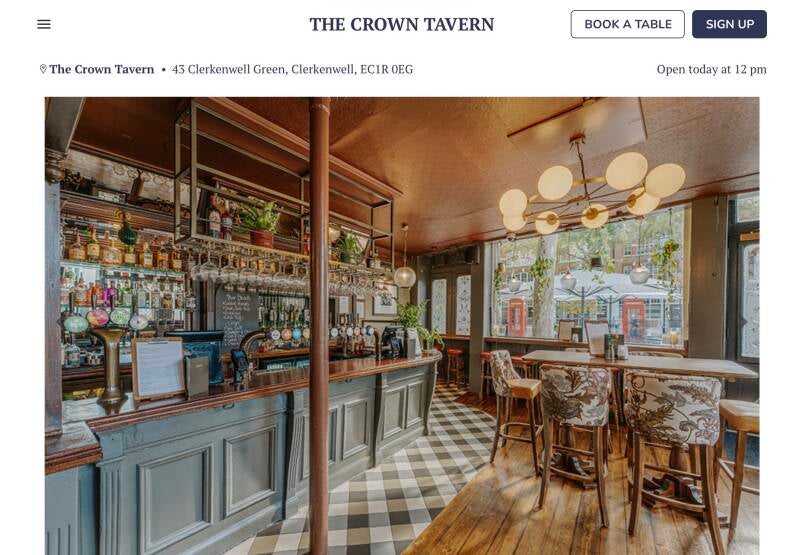
“Take a seat in the bar and you could be sitting on the spot where Lenin and Stalin held a meeting in 1905, or you may recognise the distinctive ‘golden’ Apollo Lounge, where scenes from the British film ‘Notes on a Scandal’ featuring Dame Judi Dench and Cate Blanchett were filmed. Just outside, Clerkenwell Green was the setting for Oliver Twist’s famous pick-pocketing incident…
Mixing traditional wood panelling, etched glass and period features with contemporary touches”
Clerkenwell Green
MARX MEMORIAL LIBRARY
Vladimir Lenin lived in London from April 1902 to May 1903, primarily to produce Iskra ("The Spark"), the illegal Russian Social Democratic Labour Party (RSDLP) newspaper. Working from an office at 37a Clerkenwell Green (now the Marx Memorial Library), Lenin edited issues 22–38 of the paper, which was smuggled into Russia.
The paper was printed by the Twentieth Century Press at Clerkenwell Green, arranged by Henry Quelch, and smuggled into Russia via Romania, often hidden in boots.
Lenin and his wife, Nadezhda Krupskaya, lived at 30 Holford Square in Pentonville under the pseudonym "Richter".
Lenin spent his days in the British Museum reading room researching and writing, admiring the institution's resources.
Besides Iskra, Lenin used this period to strengthen the RSDLP, planning the Second Congress and interacting with fellow revolutionaries, including Leon Trotsky. The London-based, tightly edited Iskra was crucial for organizing the Marxist movement in Russia, though Lenin later lost control of it to the Menshevik faction in 1903.
MORE ABOUT RADICAL CLERKENWELL: https://www.marx-memorial-library.org.uk/special-collections-and-subject-guides/radical-clerkenwell
THE OLD SESSIONS HOUSE, originally a court of justice
Construction began in 1779 and opened in 1782 under the name of Middlesex Sessions House as the nation’s largest courthouse. The Palladian-style building was grand, with a facade of solid Portland stone and lonic columns – some of the most expensive materials of the time. For the next 70 years, its coffered dome – built in the style of the Roman Pantheon – saw hundreds of legal cases, and prisoners marched down to the basement cells.In the early 20th century, the court was relocated and in 1931 the building became the headquarters of Avery Scales, a manufacturer of weighing machines. In 1950, the building was included on a national list of buildings of special architectural and historic interest despite the fact that over the next 30 years, Clerkenwell would go through a period of decline. With the lag in traditional industries, the building became a Masonic Lodge
PHILOSOPHY BEHIND THE RECENT DEVELOPMENT by SATILA STUDIOS: https://www.satilastudios.com/about/
Farringdon Lane
The “CLERK’s WELL”
The parish clerks of London used to perform their mystery plays, plays based on Biblical themes, in the neighbourhood, sometimes in the presence of royalty.
12th c. Crypt of the Church of the PRIORY OF ST.JOHN
The Priory Church of the Order of St John visible when standing outside today is a post war building, but down in the crypt there is still evidence to be found of the original Norman and Medieval building, part of the church’s long and fascinating history, and some of the oldest in London.
The design of the 12th century church was based on the Church of the Holy Sepulcher in Jerusalem, in that it had a large round nave, leading back to a narrow raised chancel built over a crypt.
This design was used by both Hospitaller (the order which occupied the Clerkenwell priory) and Templar churches. We can get an idea of what the circular nave may have looked like by comparing with the London Temple church
Clerkenwell Road
Routes 55 (OXFORD ST.- WALTHAMSTOW) and 243 (WATERLOO - WOOD GREEN)
St.JOHN’S GATE, originally the entrance to the Priory precinct
Built in 1504 by Prior Thomas Docwra, this gatehouse served as the entrance to the inner precinct. It now houses the Museum of the Order of St John.
More uses of the building…
CENSOR’S OFFICE: this was the home of the Revels Office (approx. 1578–1607) where Edmund Tilney, Master of the Revels to Elizabeth I and James I, licensed many of Shakespeare's plays. It served as a vital, high-security location for censorship, costuming, and staging court entertainment.
COFFEE HOUSE: the space was used as a coffee house in the early 18th century (run by Richard Hogarth, father of painter William Hogarth),
Hogarth’s Coffee House as a place for gentlemen to meet and talk in Latin.
Consequently, William Hogarth grew up in this area, and would later paint the grand staircase at St Bartholomew’s Hospital, which now leads from the museum to the Great Hall.
PRINTING SHOP: printing site for The Gentleman’s Magazine (where Dr. Samuel Johnson worked),
TAVERN: named "The Old Jerusalem Tavern".
KNIGHTS HOSPITALLER
The Clerkenwell Priory was the 12th-century English headquarters of the Knights Hospitaller (Order of St John of Jerusalem), located in what is now central London. It served as a powerful monastic, military, and administrative center until the 1530s dissolution.
- Founded around 1048 in Jerusalem, the Order originally provided medical care for pilgrims. It was formally approved by the Pope in 1113.
- Military Evolution: Due to the Crusades, the order evolved into a military force to protect Christian interests.
- European Network: The Order operated a vast network of commanderies (estates) throughout Europe that provided funding, recruits, and logistics for their operations in the Holy Land and Mediterranean.
- Rhodes (1310–1522): After leaving the Holy Land, the Knights established a sovereign state on Rhodes, becoming a dominant naval force against Ottoman expansion.
- Malta (1530–1798): Granted the island of Malta by Emperor Charles V, they continued to defend the Mediterranean. The famous 1565 Great Siege of Malta saw them successfully repel an massive Ottoman force.
- Decline and Legacy: Following surrender to Napoleon in 1798, the Order lost its territorial power but continued as a charitable organization, today known as the Sovereign Military Order of Malta, headquartered in Rome.
- Structure: The Order was organized by langues (tongues) based on the region of origin, such as Auvergne, Provence, France, Aragon, Castille, Italy, Germany, and England.
- Today, the legacy of the Knights Hospitaller continues through the Sovereign Military Order of Malta and the St. John Ambulance brigade, focusing on humanitarian aid and medical care.
St.John’s Path
Britton St.
No.55 THE HOLY TAVERN
Former BOOTH’s DISTILLERY Turnmill St. façade, rebuilt here. Redeveloped by
The TRIFFIDS (band), recorded here
Australian band who relocated to London in August 1984. Their name came from the novel "The Day of the Triffids".
19 HOUSE. Designed by for
ST.JOHN’s GARDEN

Detour
FARRINGDON railway and LU STATIONS

THE GOLDSMITH CENTRE
Eagle Court
The Bailiff of Eagle is an important office in the Order of St John and the bailiff’s house once stood just outside the Priory of Clerkenwell on the site now commemorated by Eagle Court.
Around 1340, the Hospitallers accepted the King’s offer of the Temple’s entire consecrated ground in exchange for 100 to the Crown. The agreement stipulated that upon Langford’s lease expiry in 1343, all Temple grounds would transfer to the Hospitallers. The Order of the Knights of St John then appointed their first bailiff to oversee their inheritance.
Some sources say it should properly be ‘Egle’, but that does not seem likely in view of the significance of the eagle itself (the eagle formed part of the decoration on church lecterns because it was the symbol of St John).
Cow heads?
The brick walls of the tower were embellished with bulls’ and cows’ heads modelled and cast in glass reinforced resin by Mark Merer and Lucy Glendenning. The bovine theme was used as a decorative motif because for centuries Cowcross street was part of a route used by drovers to bring cows to be slaughtered at Smithfield. Three Hereford bulls’ heads were cast into the gables on three sides of the tower. Cows’ heads were cast into the brick piers below that on two sides of the tower.
Cowcross St.
THE ROOKERY HOTEL
Rookery?
Former WILLIAM HARRIS Butcher’s premises
Famously known as the "Sausage King," was a prominent butcher and sausage manufacturer who operated near Cowcross Street in London during the late 19th century.
In 1897, Harris built impressive new premises here at 3–5 St John Street. The building on St John Street, designed by J.E. Whitty, still features a distinctive bas-relief of a wild boar and the name "William Harris 1897" on its gable end.
SMITHFIELD MARKET
Charterhouse St.
THE FOX & ANCHOR P.H.
Charterhouse Sq.
THE CHARTERHOUSE
Site of the former CHARTERHOUSE SCHOOL
FLORIN COURT: POIROT’s apartment (film location)
Hayne St.
Carthusian St.
Over Long Lane
THE RED COW P.H.
THE RISING SUN P.H.
Modelling their activities on Burke and Hare, the London Burkers started luring victims to their home in Smithfield, drugging them and murdering them. What better place to find their victims than among the drunken patrons of the taverns near to St Bart’s hospital?
The Rising Sun was one of these such pubs. It is said to be one of the most haunted pubs in London with plenty of phantom footsteps and reports of sightings.
THE HAND AND SHEARS P.H.
FARMERS AND FLETCHERS HALL
Farmers and Fletchers?
The Worshipful Company of Farmers is one of the 112 Livery Companies of the City of London. The oldest of these date back to Medieval times or even before. Our own roots stretch back to the Cornmongers Guild in the 14th century, but the present, modern company was formally established in 1952.
We achieve these aims through our very highly regarded educational courses, our annual Agricultural Lecture, our participation in the City Food and Drink Lecture, the Lord Mayor’s Show and our links with the City Farms movement and especially the Surrey Docks City Farm.
We also have strong ties with the Forces, through our affiliations with HMS Defender, RAF Waddington, The Westminster Dragoons and the Middlesex Wing of the Air Training Corps.
As the 39th Livery Company in the City of London, the Worshipful Company of Fletchers is one of the oldest of the City of London's 110 Livery Companies. But today very few of our members are involved in arrowmaking and so we exist to uphold the traditions of the City in ways that are appropriate to our heritage.
The main focus of our charity, the Fletchers Trust, is providing equipment to archers with disability.
We were proud to have been able to assist members of the GB Paralympic Archery Squad in Athens 2004, Beijing 2008, London 2012, Rio 2016 and most recently, Tokyo
FOUNDERS HALL
Cloth Fair (Street)
Merchants gathered to buy and sell fabric during the Bartholomew Fair.
was originally within the precincts of the Priory of St. Bartholomew's, and until 1910 formed a separate liberty, with gates that were shut at night. Such a small area could not meet the demands of installing street lighting and sewers, and rejoined the city.
Pre-1666 HOUSES
The houses are outside the area affected by the GF but did have survived attempted slum clearances.
Its use of brick is considered to be an early example with England
In 1930, restoration work on the building was carried out by Seely and Paget with careful attention given to the architectural history of the building, intending to maintain the original elements of the existing structure
Partners
John Seely, son of John Seely, 1st Baron Mottistone, and Paul Paget, son of Bishop Henry Luke Paget, met at Cambridge University, where Seely studied architecture, though Paget did notWhen Seely came down from Cambridge, he insisted that Paget join him in architectural practice, even though Paget had no architectural training. In the partnership, Paget concentrated on working with clients on their requirements, while Seely carried out the design work.
From 1930 they lived and worked together at 41 Cloth Fair, London, where the firm remained until 1986.They had what Paget described as a "completely common life together", and installed twin bathtubs so they could bathe together.
JOHN BETJEMAN’s “love nest”
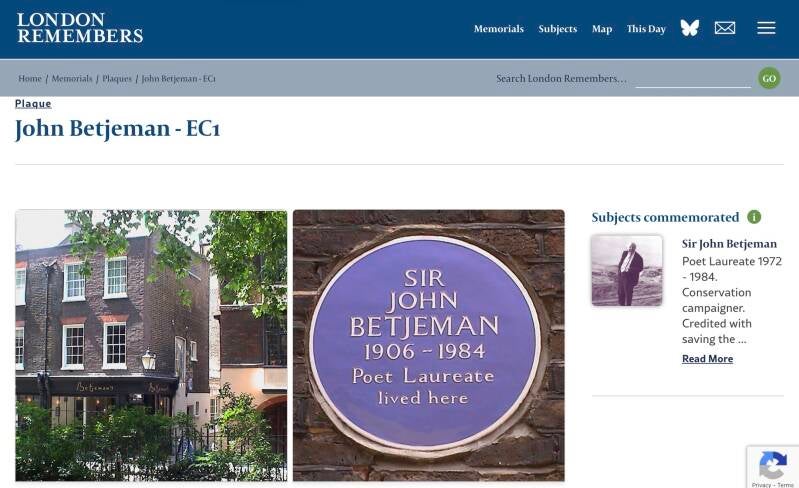
Poet Laureate from 1972 until his death. He was a founding member of The Victorian Society and first president of The Hackney Society and a passionate defender of Victorian architecture, helping to save St Pancras railway station from demolition. He began his career as a journalist and ended it as one of the most popular British Poets Laureate and a much-loved figure on British television.
ST.BARTHOLOMEW THE GREAT Church


East façade
Lady Chapel (and Crypt)
Apse
North Façade
North Transept
Former graveyard
Cloister
Gatehouse
The church was founded in 1123 by Rahere, a prebendary of St Paul's Cathedral and an Augustinian canon regular. While at the Vatican, Rahere dreamed that a winged beast came and transported him to a high place, then relayed a message from "the High Trinity and...the court of Heaven" that he was to erect a church in London's Smithfield. Rahere travelled to London and was informed that the area in his vision – then a small cemetery – was royal property, and could not be built upon. Henry I, however, granted title of the land to Rahere upon hearing his divine message.
The priory gained a reputation for curative powers, with many sick people filling its aisles, notably on 24 August (St Bartholomew's Day). Many miracles were attributed to occur within and without the walls of the building, including "a light sent from heaven" from its first foundation, and especially miraculous healings; many serious disabilities were claimed to be cured after a visit.[8] Many of these cures were undertaken at the church hospital, the still existing St Bartholomew's Hospital.
While much of the hospital survived the Dissolution of the Monasteries, about half of the priory's church was ransacked then demolished in 1543. the surviving parts of the church fell into disrepair. [12] During Canon Edwin Savage's tenure as rector, the church was further restored at the cost of more than £60,000.[13] The surviving building had comprised part of a priory adjoining St Bartholomew's Hospital,[14] but its nave was pulled down up to the last bay although the lofty crossing arches and choir survive largely intact from the Norman[15] and later Middle Ages, enabling its continued use as a parish church.
A half-timbered gatehouse was added in 1595, above a 13th century stone arch. Later hidden behind a Georgian shop front, a WWI zeppelin raid blew the façade open revealing the extraordinary Tudor structure beneath.
A set of heraldic gates were added in 1932, with the coats of arms of Henry I and the church’s restorers. The gatehouse had become dark and dingy, the handsome iron lanterns were not working, the paint was flaking and the ironwork was corroded.
Three bays of the semi-derelict c.15 cloister were restored and extended by a further five bays in replica in the 1920s as a war memorial the new work using the surviving medieval footings. The approximate footprint of the cloister quadrangle was recreated as a grassed area when adjoining buildings were redeveloped in 2019. The approximate extent of the monastic enclosure is defined by the modern street of Bartholomew Close and Cloth Fair
BART’S HOSPITAL
Victorian extension
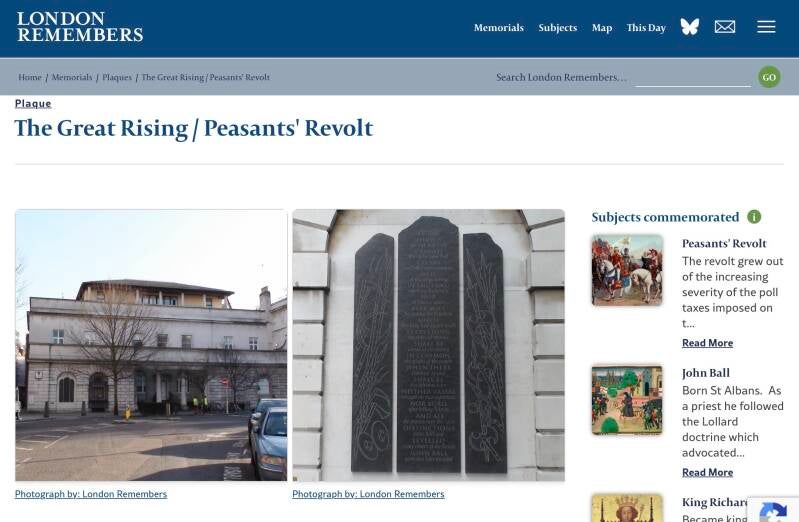
PEASANTS’ REVOLT
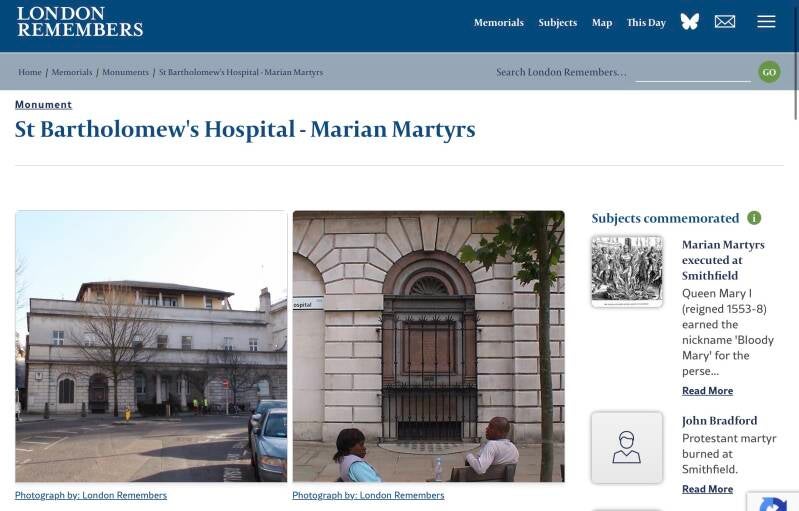
PROTESTANT MARTYRS

Zepelin bombings?
HENRY VIII GATE
ST.BARTHOLOMEW THE LESS Church
PRINCESS ALICE GARDEN


MUSEUM

THE SQUARE
GEORGE V BUILDING
BARTS 21rst c. Redevelopment
https://find-an-architect.architecture.com/hok-international-ltd/london/st-bartholomews-hospital
SHERLOCK locations
HABERDASHERS HALL
Giltspur St
It was formerly known as Knightsriders Street, from the knights riding at the tournaments in Smithfield
Cock Lane
The GREAT FIRE of 1666… was put out HERE: the GOLDEN BOY
This PLACE used to be Pye Corner
The Boy at Pye Corner (PIES!) was erected to commemorate the staying of the Great Fire which, beginning at Pudding Lane (PUDDINGS!)was ascribed to the sin of gluttony when not attributed to the Papists as on the Monument, and the boy was made prodigiously fat to enforce the moral.
Why Pye Corner?: meat, pork, chicken and mushroom, apple…pies?
Not at all!. The sign of the magpie was once at this corner and it was from this bird that this corner became known as Pie Corner. A public-house called 'The Fortune of War' used to occupy this site and was pulled down in 1910. And, in effect, the boys statue was originally built into the front of the pub.The figure is of oak and from the late 17th century while the inscriptions are more recent. There seems to be no evidence that the boy (not particularly fat) was erected to commemorate the Great Fire. It's more likely that the figure was a shop sign.
Let’s go back to the disappeared pub now…
Think now about the old hospital. Back in the 18th. medical research was all the rage. Surgeons needed bodies. Great time for the body-snatchers, robbers of bodies from churchyards (a church is nearby)…
The Fortune of War' was the chief house of call north of the river for resurrectionists in body-snatching days years ago. The landlord used to show the room where on benches round the wall the bodies were placed, labelled with the snatchers' names, waiting till the surgeons at Saint Bartholomew's could run round and appraise them (Philip Ward-Jackson's 'Public Sculpture of the City of London')
ROMAN WALL
WATCHHOUSE
A watch house was an early form of local police station but we've heard it said that this particular watch-house did at one time shelter the guards charged with preventing grave-robbing in the St Sepulchre graveyard. This is the last City of London watch-house standing.
“Watchhouse” is a chain of coffeshops…

This building became the first branch…
Site of the GREYFRIARS monastery, then CHRISTS HOSPITAL or the BLUECOAT SCHOOL
a Conventual Franciscan friary that existed from 1225 to 1538 on a site at the North-West of the City of Londonby Newgate in the parish of St Nicholas in the Shambles. It was the second Franciscan religious house to be founded in the country.[1] The establishment included a conventualchurch that was one of the largest in London, and a studium or regional university, with an extensive library of logical and theological texts. It was an important intellectual centre in the early fourteenth century, rivalled only by Oxford University in status. Members of the community at that time included William of Ockham, Walter Chatton and Adam Wodeham. It flourished in the fourteenth and fifteenth century but in the 16th century, it was dissolved at the instigation of Henry VIII as part of the Dissolution of the Monasteries of 1538. Christ's Hospital was founded in the old conventual buildings, and the church was rebuilt completely by Sir Christopher Wren as Christ Church Greyfriars after the original church was almost completely destroyed in the Great Fire of London of 1666, and Wren's church was ruined in the London bombing of World War II. A memorial garden occupies the ruins, and a building now stands on part of the priory, designed by Arup Group Limited, currently occupied by Merrill Lynch.
CHARLES LAMB studied here (on the other side of the road)

Christ's Hospital was the result of the foundation by Henry VIII and confirmed by Edward VI, assisted by Nicholas Ridley, Bishop of London, and Sir Richard Dobbs, Lord Mayor of London.[6] Its genesis was the earlier dissolution of the monasteries and the resultant overflow onto the streets of the poor and destitute. Encouraged by a sermon from Ridley, exhorting mercy to the poor, the king wrote to the Lord Mayor encouraging him to action. This he did via a committee of 30 merchants.
Henry VIII had already granted the use of Greyfriars to the city for the relief of the poor and to house the homeless children which the magistrates had taken notice of.[7] In 1553 (26 June, 7 Edw. VI) Edward granted Bridewell Palace, his lands at the Savoy, and rents and other chattels to create three Royal Hospitals – Christ's Hospital, Bridewell Hospital (now the King Edward's School, Witley, Surrey) and St Thomas' Hospital. The three institutions use the same coat of arms, although slightly modified by the latter.
Current school

Newgate St.buildings

School memorial

BACK OF THE MONUMENT: https://www.londonremembers.com/memorials/christ-s-hospital-school-sculpture-back
Memorial to the ROYAL MATHEMATICAL SCHOOL: https://www.londonremembers.com/subjects/royal-mathematical-school?memorial_id=11189
CITIZENS MEMORIAL: https://thecitizensmemorial.wordpress.com
Church of the ST.SEPULCHRE

Create Your Own Website With Webador