


CITY OF LONDON (ROMAN WALL) BUNHILL FIELDS WESLEY’S CHURCH HOXTON Former GAINSBOROUGH CINEMA STUDIOS (Shortcut to Islington) DE BEAUVOIR TOWN ISLINGTON
Noble St.
ROMAN FORT
WILLIAM SHAKESPEARE lived here
London Wall
Fore St.
Site of CRIPPLEGATE
The name ‘Cripplegate’ had nothing to do with cripples. The original gate in the City’s wall was particularly lacking in head room, and so the gate became known by its Middle English nickname, Crepul Gate – meaning a gate for creeping through.
BARBICAN
CRIPPLEGATE Church
ROMAN WALL
SALTERS HALL
Remains of ELSYNG HOSPITAL
Silk St.
BARBICAN entrance
Former WHITBREAD BREWERY
Chiswell St
BARBICAN CINEMAS
Golden Lane
BANKSY: MEMORIAL to BASQUIAT
Former CRIPPLEGATE INSTITUTE and LIBRARY
Fortune St.
Site of THE FORTUNE PLAY-HOUSE

The Fortune Theatre (built 1600) is crucial to understanding Elizabethan theatre because its surviving 1599 builder’s contract is the only extant, detailed legal document describing the construction, layout, and materials of an outdoor, public London playhouse. Built by Edward Alleyn and Philip Henslowe as a rival to the Globe, it provides unparalleled architectural insight, such as its square shape, dimensions (80ft square), and capacity for over 2,000 spectators.
Over Whitecross St.
WHITECROSS ST.

Dufferin St.

Nearby
QUAKER MEETING HOUSE and gravestone of GEORGE FOX

This garden is on the site of Bunhill Fields Burial Ground which was acquired by the Society of Friends (Quakers) in 1661. The remains of many thousands of Friends lie buried here including George Fox, the founder of the Society of Friends who died 13th January 1691.
Over Bunhill Row
Nearby
HONORABLE ARTILLERY COMPANY

As the oldest regiment in the British Army, it was set up by Henry VIII back in 1537 to offer support to the now prestigious establishment. Since 1768, the HAC has provided Guards of Honour in the City for visiting members of the Royal Family, overseas Heads of State or Commonwealth Prime Ministers.
The HAC can trace its history back as far as 1087,[9] but it received a royal charter from Henry VIII on 25 August 1537, when Letters Patentwere received by the Overseers of the Fraternity or Guild of St Georgeauthorising them to establish a perpetual corporation for the defence of the realm to be known as the Fraternity or Guild of Artillery of Longbows, Crossbows and Handgonnes.[10] This body was known by a variety of names until 1658, when it was first referred to as the Artillery Company.[11] It was initially referred to as the Honourable Artillery Company in 1685 and officially received the name from Queen Victoria in 1860
Buildings and grounds
Now, the historic venue is used by current and ex-members of the Regiment to meet, socialise and discuss business. The Georgian manor house and Artillery Garden are also available for a range of private and corporate events such as conferences, weddings, Christmas parties, dinners and sporting matches.
With large cannons flagging the main entrance to the Grade II-listed building, Armoury House creates an immediate impression as an unexpected gem amongst the glass and steel of the City. Indoors, there are five equally beautiful yet unique spaces available for hire.
Upon entry to the manor house, the large staircase takes centre stage in the tall hallway. Positioned just before the staircase are the Queens Room and the Ante Room, both benefiting from floods of natural daylight and charm. The largest being the Long Roomlocated on the first floor, a wood-panelled space filled with character and charm.
If you’re looking for a large blank canvas space in the heart of London, then the Prince Consort Rooms are ideal. With their private entrance and Courtyard, the PCR is a dream for large VIP events, conferences or weddings. Converted from the Regiment’s former drill hall, this space offers a neutral contemporary ambience that you can adapt and transform to suit your event vision.
To take the tour around our Grade II listed Georgian property, use our virtual tour.
BUNHILL FIELDS, the NON-CONFORMISTS burial ground
Over City Road
Unlike other Roman-origin gates, Moorgate was built in the 15th century to provide access to the marshy moorlands (Moorfields) north of the city.
The modern street of Moorgate was laid out in 1834 and developed around 1846 to create a new approach to London Bridge.
The contemporary street of Moorgate runs north from Princes Street and Lothbury at the back of the Bank of England, across the road named London Wall and the location of the old gate, and then continues north. After leaving the City of London in the direction of the London Borough of Islington, the street is known as Finsbury Pavement (which at one time was known as Moor Fields Pavement) and then City Road.
WESLEY’S CHAPEL & MUSEUM OF METHODISM


Epworth ST.
The f ounder of the Methodist denomination of the Protestant religion was born Epworth rectory, near Lincoln.
Tabernacle St.
Site of THE FOUNDERY

Nearby

Forty yards south of this building on the east side was the site of The Foundery, John Wesley's headquarters 1739 - 78 and the first Methodist Book-room. The mother of the Wesleys died there 30th July 1742.
Erected by the British section of the International Methodist Historical Union.

Site of the WHITEFIELD or MOORFIELDS TABERNACLE. Former CONGREGATIONAL Church
The earliest place of worship at this location was constructed from wood by those who followed the evangelical minister George Whitefield. This structure was subsequently replaced with a brick building in 1753. In 1868, the church underwent another transformation when it was reconstructed in stone, following Gothic architectural principles designed by C. G. Searle & Son.
A new church establishment opened its doors in 1907 near Alexandra Park, drawing many worshippers away from the Moorfields congregation who chose to transfer their membership to the new location.
CENTRAL FOUNDATION SCHOOL
FOUNTAIN

Former FIRE STATION
To the right: Great Eastern St.
Over Old St.
Nearby
Rivington St.
BANKSY at the ART’OTEL
Pitfield St.
Coronet St.
Former THE HOP POLE PH
The attic storey has been extended, with a full length mansard. Lead faced dormers, in the original dormer o serve the ornamental terracotta surround.
Dark green faience, and fascia of cream tiles. Terracotta architraves.
Former POWER STATION, now NATIONAL CENTRE FOR CIRCUS ARTS
ïYou could be getting a university degree here, now. This is a leading centre that supports the professional development of CIRCUS performers and companies, and runs adults and children classes.
JONATHAN GRAHAM started it, in NORTH ROAD (1989). Helping performers and companyies, decisions spaces for practicing and performing, putting on shows… in 1994 the institution moved here, and the following year was authorised to deliver a NATIONAL DIPLOMA.
In 1998 a tailor made training program was devised for aerial artists performing and the MIL at the MILLENNIUM DOME, now THE O2, NORTH GREENWICH.
In 1999 was created a 2 year BA course, in association with the CENTRAL SCHOOL OF SPEECH & DRAMA, WEST HAMPSTEAD, and validated by the UNIVERSITY OF KENT. In 2014 a new BA, CIRCOMEDIA, by the UNIVERSITY OF BATH SPA was created.
The GENERATING COMPANY was f. here.
Deaf and disabled artists, including soldiers, had a training program set up, so they would perform in the 2012 PPGG OPENING CEREMONY.
Star members of the CIRQUE DU SOLEIL and the RSHKCo have been trained here, SADIE FROST, STEPHEN DALDRY, DANIEL KRAMER, LUCY MECKLENBURG

This building dates from 1897. It housed the destructor hall, 3 engines and storage bins. A 80 ft chimney stack. And, next door Library (and small Museum), Public Baths and Washhouses. And municipal offices.
The first UK system of local waste and refuse disposal, used to generate power, which was later used for street lighting and for the neighbouring public buildings. An example of state (in fact, local authority, as this was built by the SHOREDITCH VESTRY) intervention, allowed by the 1882 ELECTRICAL LIGHT ACT, which allowed to purchase private undertakings after 21 years of operation ( extended to 42 years in 1888, as the private companies were no able to recoup their investments, in only 21) to create monopolies on the public interest.
Recycling, what a (not so new) marvel!.
LIGHT AND POWER FROM DUST!. That is, electricity was recognised as the fuel of the future. And here, an interventionist administration took the matter in its own hands. Not everywhere in London was like this.
Anyway, this was one of the largest power consuming districts (factories and workshops, warehouses, 300 PHs, shops open all night…) and the, rather leftist VESTRY resented that private profit was made at the expense of local needs.
And there was and additional problem to solve: it had to deal with 20.000 tons of municipal refuse each year!. An innovative solution beckoned. As the BOARD OF TRADE has granted to SOREDITCH the license to supply energy, the Vestry commissioned Eng. EDWARD MANVILLE to conduct a feasibility study of a combined DUST DESTRUCTOR PLUS ELECTRICITY GENERATING STATION. He concluded that the undertaking had scope for development, and the voters endorsed the proposal.
In the open ceremony, a part from municipal pride, was present the physicist LORD KELVIN, who praised the Vestry for being technologically progressive, and Mr.STUART, LABOUR MP praised it for serving the humble population.
NILE STREET tenements were the first ro have electricity supply, in 1899. By then, who opened the new flats was the EARL OF ROSEBERRY, Chairman of the new,y formed LCC. The Vestry as no more but, very appropriately , the new BOROUGH, part of the new LCC, embraced it: MORE POWER, MORE LIGHT. In fact, the Borough continued to be a progressive authority, where LABOUR took hold firmly.
And demand expanded, supply expanded. A second generating station was built in WHISTON ROAD, HAGGERSTON, this one fired by coal, supplied thanks to the canal, as there was not enough rubbish to satisfy demand.
By 1924, 43 miles of the Borough were cabled, in 1926 a RENTAL WIRING SCHEME allowed households to have electricity with no upfront cost, paying 1’5 d per unit. The had installed lamps and shades, fixed by the ELECTRICAL DEPARTMENT staff, and, as well slot meters and maintenance where included.
SHOWROOMS were opened in HOXTON STREET, in the corner of OLD ST.
The NATIONAL GRID was created in 1927. We were entering the ers of large scale generation. The era was heralded by the building of BATTERSEA POWER STATION, in 1933.
But, during WW2, small generation here provided a back up, when large stations were affected by the bombs. And gain in 1947, due to the coal crises.
CHARLES SQUARE
A fashionable 18th residential square, like HOXTON SQUARE. Now, completely redeveloped, only one 18th c. building stands on its West side.
THE PRINCE ARTHUR P.H.
Former PUBLIC LIBRARY
Opened in 1896, and funded, as so many in the EAST END, by PASSMORE EDWARDS (1823-1911), who, coming from a humble Cornish village, became a journalist, then editor, MP for SALISBURY, and a champion of the working classes.
Former PUBLIC BATHS
After the damages suffered during WW2 they had to be demolished. A sympathetically designed building occupies the site.
THE COURTYARD THEATRE
CONSERVATOIRE MUSIC AND DANCE
Nos. 18-20. Site of the VARIETY THEATRE
Associated with the WHITE HORSE PH. Arch. PHIPPS,, 1869. The site was rebuilt in 1994
No. 41. Former, and handsome, FURNITURE WAREHOUSE
White round keystone on round windows, glazed tiles, square brick column’s decorations
Site of ASKE’s ALMSHOUSES and SCHOOL
ROBERT ASKE was a silk merchant and member of the HABERDASHER COMPANY, and, in 1689, legate land and £20.000 to be invested to provide ALMSHOUSES for the poor and a SCHOOL for 20 poor sons of FREEMEN.
ASKE’S HOSPITAL was built here, 1690-93, designed by ROBERT HOOKE, associate of SIR CHRISTOPHER WREN.
1827. The HABERDASHER’ COMPANY rebuilt the venue in a GREEK/REGENCY style, by an arch, -DR.ROPER- who had provided the valuation of the properties needed for the laying down of REGENT STREET.
The building was altered in 1873
In 1898 the institution was transferred to the LCC, who established here the newly founded SHOREDITCH TECHNICAL INSTITUTE, now COLLEGE, transferred to COOPERS HILL, in 1951.
Later on, the LONDON COLLEGE OF FURNITURE occupied the building, until transferred to the CITY & ISLINGTON COLLEGE.
Finally, converted into 38 apartments, 1 studio and 1 house.
To your left, Buttesland St.
Built 1810-35, on the HABERDASHERS’ ESTATE, a terrace of 7 properties. With round headed doorways, with fanlight. The roof and the chimneys are concealed behind the parapet. Some sash windows are original.
67-73
62-65
60-61, Victorian
To your left, Charter St
17-23 Georgian
Site of GAUMONT CINEMA, now HOXTON CURZON
B.1914, with a cap. of 866 spectators. Closed during the BLITZ but open during the rest of the War. It became part of the RANK chain, but closed in 56. Meatpackers, importers and wholesalers used the building, then artists, until plans were made by the SHIREDITCH TRUST to restore it.
In fact, it has been completely rebuilt, up to the GF, in reinforced concrete, and with CROSS LAMINATED TIMBER modular frame, upwards. Cinema, restaurant and 18 apartments.
The heritage façade has a modern extension of lightweight zinc-clad pavilion shaped.
Arch. WAUGH THISLETON
THE GEORGE AND VULTURE P.H.
The tallest pub building in London?.
Haberdasher St.
Part of RA’s bequest. Nos.57-145. C.1900 artisans’ flats. Roof railings
Haberdashers PLACE

Site of the PIMLICO PLEASURE GARDENS and HOSTELRY

Pimlico?. Sounds familiar… VICTORIA STATION is in PIMLICO!. BUCKINGHAM PALACE is in PIMLICO… But there are miles away!.
A foreign looking name?.
In the last TUDOR and the STUART times, BEN PIMLICO, originally from Italy (?) owned an ale house which became famous, and particularly sought after was his nut brown ale. The pleasure gardens in which it developed became at the centre of the area, where pleasure gardens sprang up, and PIMLICO became the popular name of this area denoting those places of entertainment. It seems that another venue, started or not by Mr.Pimlico, was called PIMLICO, and the name stuck!.
The poem A MAD WORLD OF HOGSDON contains the lines: “Doctors, Proctors, Clerks, Attorneys to Pimlico make sweetly sweethearts journeys”
ST.JOHN THE BAPTIST Church
Here, JOHN GOLDSMITH, Maternal GGGG father of KATE MIDDLETON, or CATHERINE the PRINCESS OF WALES, married ESTHER JONES, 1850.
The only church designed by the arch.FRANCIS EDWARDS, SIR JOHN SOANE’s foremost pupil, was built and consecrated in 1826. HOXTON was not anymore part of the parish of ST.LEONARD.
It is one of the CHURCH COMMISSIONERS’ churches, as well called, a WATERLOO CHURCH, or a MILLION ACT CHURCH. It held a congregation of 2.000.
The original floor plan has been kept intact, the galleries are notables. The painted ceiling and other decorations are spectacular. They were designed by arch. JOSEPH ARTHUR REEVE, in the 20th c. The organ case is Georgian, the organ itself, from 1915, was restored in 1934. The Coat of arms is that used. Y WILLIAM IV.
The churchyard was open to the public in 1882.
The first vicar was responsible for the founding of the NATIONAL SAVINGS BANK, London’s largest, and the ST.JONH’S NATIONAL SCHOOLS, following a local campaign and the advise of CHARLES BOOTH.
The school, was in NEW NORTH ROAD, with a capacity for 800 kids. It was successively replaced by a SBL school, a b by the current Primary.

Detour and shortcut to Islington: former GAINSBOROUGH STUDIOS (Alfred Hitchcock)
BUS ROUTES ALONG KINGSLAND ROAD
LONDON OVERGROUND: HOXTON STA.

SHOREDITCH PARK

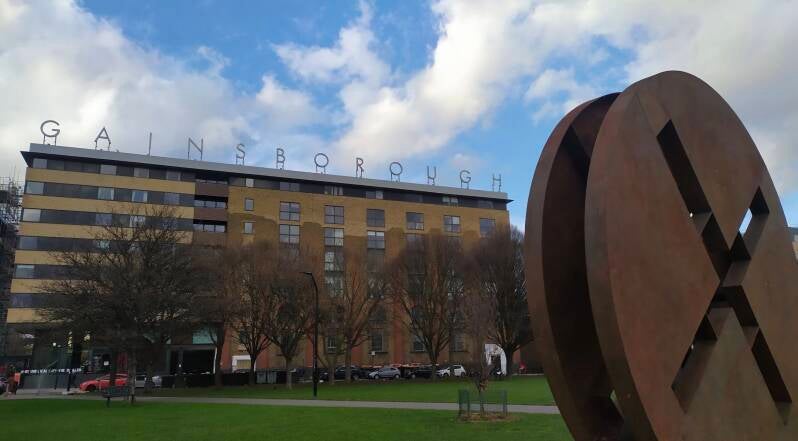


Immediatel 3 things come to your attentional you walk the in diagonal Nort-Westerly:
2 art works and a warehouse-looking building with a big name on it. And you recognise the name (if you are a cinema fad!).
As you get closer to the stone you recognise that it is a boulder. It comes from a quarry in CORNWALL and the sculptor climbers are welcomed. In fact it is boulder NO.1. NO.2 is in MABLEY GREEN, HACKNEY WICK.
The other piece of art is HITCHCOCK REEL. Mos, all becomes obvious: the building in front of you where used by the GAINSBOROUGH FILMS, as studios, and AH worked here.
I encourage you to inspect the building more closely: you will find an immense bust of AL, inside the modern courtyard. The plaque remembering you of the history is outside.
HITCHCOCK beginnings

After Hitchcock, Lenin and Stalin…
Balmes Road
Site of BROTHERHOOD Church
Now, you will have an encounter with LENIN, STALIN, TROTSKY!
See the TESCO?. 100 years ago, on the corner of the SOUTHGATE ROAD and BALMES ROAD used to be a church. In 1907 The 5th Congress of the RSDLP was held in London, specifically at the Brotherhood Church in Southgate Road. This congress saw 366 delegates, including Lenin, Trotsky, and Stalin, and solidified Bolshevik control.
A TOLSTOYAN CHURCH!: https://en.wikipedia.org/wiki/Brotherhood_Church
Site of BALMES HOUSE
Baumes, or Balmes (from two Spanish merchants so named), stood west of the Kingsland-road, Hoxton, and was taken down in 1852. It was built by the Balmeses, about 1440; Sir George Whitmore resided here occasionally when lord mayor, 1631; and on this spot Sir W. Acton, lord mayor, with the aldermen, &c., waited the arrival of Charles I. on his return from Scotland, Nov. 25, 1641; when the royal coaches were conducted, by a road formed for the occasion, through Balmes's grounds to Hoxton, and thence to Moorgate, into the City, the road between Kingsland and Shoreditch being then impassable by "the depth and foulness of it." Baumes-march was long a favourite archery and artillery exercise;* [* The Robin Hood public-house (now refronted) originally looked over Finsbury-fields, and was much frequented by the metropolitan archers; the sign, Robin Hood and Little John, in Lincoln-green, formerly swung from a tree before the door. A few dealers in archery implements, and preservers of animals, have lingered in the City-road to our day-the last relics of the chivalry of Hogsden, Finsbury, and Moorfields.] but the ground attached to the house is now the site of De Beauvoir Town, named from the De Beauvoir family, its owners since 1696. A print of 1580 shows Baumes, with its gate-house, farmery, spacious gardens and grounds, avenues of fruit-trees and stately elms; and the Italianized brick mansion with its two-storied roof, moated and approached by a drawbridge; the house and moat were supplied from the ancient well in Canonbury Field. The interior of Balmes was rich in carved ceilings, panelling and staircase, armorial glass and tapestry.
Bridport Place


THE ROSEMARY BRANCH P.H.

Former SOUTHGATE ARMS P.H.

ROSEMARY GARDENS. Site of ISLINGTON VAUXHALL, later on the site of industrial premises

The Rosemary Branch is actually in Islington but often referred to as being in Hoxton. A Rosemary Branch with a tea garden was on this site since at least 1823. Also known as the Rosemary Branch Equestrian Theatre, it held regular pony racing events, though a timber circus building burnt down in 1853


Manufacturers of weighing machinery.
THE BARING P.H.
WILTON SQ.

Road was constructed in 1812. Building began on the Clothworkers’ Estate in the 1840s and the Wilton Square site together with part of New North Road was leased by Richard Field, a printer and ‘commission agent for bandannas’. Field withdraw from the Wilton Square site, which reverted to the Clothworkers’ Company and in 1851 it was leased by Edward Rowland and Thomas Evans, who built Wilton Square and Wilton Street by 1853, the latter renamed Wilton Villas in 1940.
UNION SQ.
ARLINGTON SQ.
For centuries, the area where we now live was a popular spot for archery practice. (A 1514 law in made it compulsory for all men over seven years old to practice archery once a week – a law, incidentally, that still seems to be in force.)
It was also agricultural land, denoted on an 1805 map as Shepherd and Shepherdess Fields. This was where sheep farmers from out of town would overnight their flocks before driving them down Shepherdess Walk to the meat and livestock market at Smithfield.
The building of the New North Road in 1812 and the opening of the Regent’s Canal in 1820 made the land more valuable for residential use, and between 1845 and 1850 the developer Henry Rydon created the streets and houses we know today. Arlington Square and Union Square were left as green spaces for the new residents to enjoy (and presumably not archers or shepherds). By 1870 they had acquired curving paths, lawns and peripheral planting.
PACKINGTON ESTATE
This part of modern-day London was still farms owned by the cathedral when they were seized and sold to the City of London livery company, the Worshipful Company of Clothworkers. The Clothworkers estate grew in 1563 when they were donated 60 acres of archery practice land by Dame Ann Packington.
Jump forward a couple of hundred years, and the arrival of the Regents Canal spurred housing developments in this part of London, and the Clothworkers got to work.
The history as a former Cathedral farmland is why so many of the streets have names like St Paul’s Street, Mary Street, Bishop’s Street, Canon Street, and the Packington Estate. Housing developments require services, and at the time, that meant a purpose-built church
The estate: From Victorian times to our days
a dense network of Victorian terraces flattened to make way for 27 six storey slab blocks. the regeneration was deeply unpopular, hard to let – as well as notorious for a ‘gang culture’. Even residents who liked it complained about problems with the estate’s central heating system; roofs leaked and empty homes attracted squatters Throughout the 80s, improvements were made
In a 2004 survey of residents’ views about redevelopment, 86 per cent wanted a new development to reinstate the traditional street pattern. transfer of ownership from Islington council to the Hyde Group. Hyde subsequently made plans to demolish and rebuild all blocks in several stages,
The winning bid from architects PTE was distinguished by its plan to reinstate streets into the heart of the estate. This proved exceptionally popular with residents. Packington stands apart from other large estate regeneration projects Hyde concede they would probably have built higher and denser without the restraint advocated by residents this scheme is also distinguished in that it prioritises social cohesion. key element here though is that houses in UNION SQ. are not for sale, but have instead beenallocated to low income local families at a cost of £112 a week.


Possible diversion, another route towards Central Islington

Bus routes along ESSEX RD.

ESSEX ROAD RWY STA.
St.JAMES’s Church
Britannia Row
Packington St.

Over Essex Road, then 2 possible routes
Cross St.
53 CROSS STREET
FRAME FACTORY
LITTLE ANGEL THEATRE, a puppets theatre

The 100-seat theatre, a former temperance hall, was opened on 24 November 1961 by founders John and Lyndie Wright,[2] with a performance of The Wild Night Of The Witches.
As well as being a recognised theatre, Little Angel Theatre works with its local community to tackle barriers to arts engagement so all can benefit and enjoy the art form of puppetry.
St.MARY’S Church

Noel St.
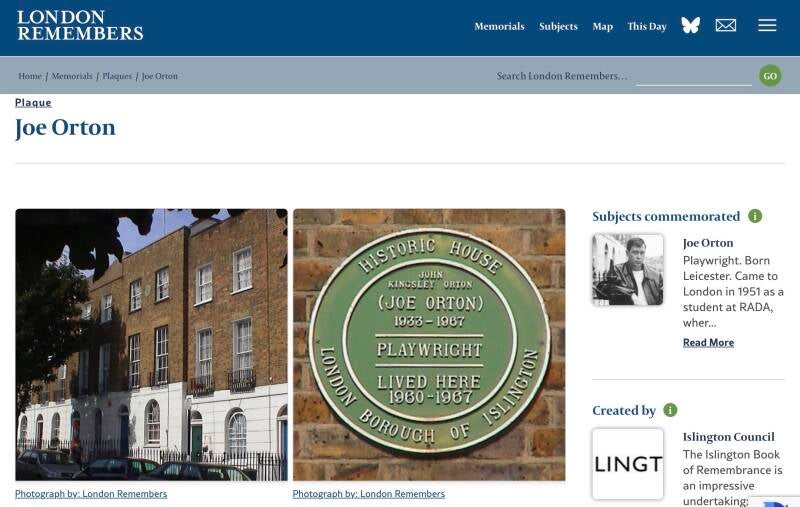
JOE ORTON lived here
Sentenced to prison…
1962 aspiring writer Joe Orton (1933-67) and his partner and mentor Kenneth Halliwell (1926-67) wereeach sentenced to six months imprisonment for ‘malicious damage’ to Islington Public Library books.They were found guilty of theft and defacing library book covers by adding alternative images from othersources or inserting new text and narrative. In the process Orton and Halliwell produced ‘guerrillaartwork’, motivated by the “endless shelves of rubbish” that they found in public libraries.

The REGENT’S CANAL: ISLINGTON TUNNEL
Welcome to Central Islington (Upper Street)

End of the detour or shortcut to Islington
Back to Pitfield St. and regular route to De Beavoir and Islington
TRUE JESUS CHURCH
SHOREDITCH PARK
BRITANNIA LEISURE CENTRE
SCHOOL
Whitmore Bridge
REGENT’S CANAL
De Beauvoir Road
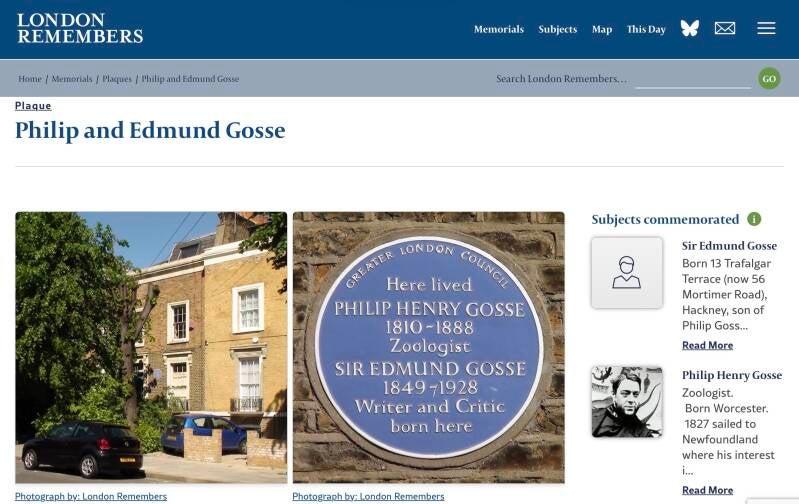
GOSSE, fathers and son
De Beauvoir Sq.


It constitutes the centre piece of the estate. Built primarily in a JACOBETHAN style, popular in England in the late 1820s, derived, in inspiration and repertoire, from the ENGLISH RENNAISSANCE, with ELIZABETHAN and JACOBEAN. JOHN BETJEMAN coined the term in 1933
The BENYON ESTATE

DE BEAUVOIR IS French name!. Do not pronounce it the way a Gallic speaker would do it: no one will understand you!. “Debivar”, “debouvar”… pronounce as you wish. And it has a nickname: BEAVERTOWN.
RICHARD D.B. purchased the BALMES ESTATE in 1640
Up to mid 19th c. Open countryside and a few ground houses. A new town was carefully planned and designed to attract prosperous, UPPER CLASS, residents.
The opening of the REGENT’ CANAL prompted the operation.
Developer and brick maker, WILIAM RHODES, grandfather of CECIL, secured a lease from PETER D.B.
Grid patt., 4 sq, on diag str, intersex at an octagon
Work stopped due to court case, which dragged for 20 y. The D.B. family got the land back, as the lease was found unfair. And the prospective dwellers chose to live in the WEST END!
The scheme was scaled down. Only one square and a few diagonal streets
In the 1840s emerging mid cl were occupying the residential estate, except around KINGSLAND BASIN and the SW corner where a factory was leased
In 137 the SE. corner was re zoned for industrial use. DE BEAUVOIR CRESCENT was suggested as business zone in 1938
In the 1960s the KINGSLAND EST. , the DE BEAUVOIR EST. and the LOCKNER RD. EST. were built.
To stop this estate building trend by the H.C., D.B.ASSOCIATION formed (Chairman GRAHAM PARSEY). The area was designed CA and enlarged. GLC Introduced children friendly and traffic calming or reducing measures
Gentrification: DELI, ROSEMARY BRANCH & STUDIO THEATRE
Multicultural, though
28 Weeks Later” film
Stay With Me”, Sam Smith music video
ST.PETER Church DE BEAUVOIR TOWN


B 1841, at the expense of RICHARD BENYON DE BEAUVOIR, to enhance the character and add lustre to the new estate.
From 1843 the crypt was used as a school.
In 1869 it became a parish church.
In 1889, extended Eastwards, the Chancel was raised, a room was added in the crypt. New pews and new organ.
In 1939 the crypt was requisitioned for AIR RAID PRECAUTION.
In 1955 the parish minutes estate: “be sociable and helpful to the immigrants from the WEST INDIES”,“treat them as fellow Christians, not embarrassingly over-helpful or over-friendly “.
In 1958 the crypt fills in completely during ROCK’N’ROLL NIGHTS, only the audience to decline when CLIFF RICHARDS performs in HACKNEY WICK.
In 1977 takes place an internal reordering.
In 1989 the crypt provides shelter for KURDISH refugees. Part of it is converted in DE BEAUVOIR REFUGEE PROJECT, in ‘96.
In 2002 JULIA PORTER-PRYCE, first woman vicar.
In 2012 the crypt becomes a community space.
In 2014 a special service and an exhibition, in memory of the 163 soldiers from the locality who died in the Great War,

A further up
A HOUSE… Stamford Rd. junction with Mortimer Rd.

WILLIAM LITTLE inherited the house, and began digging, downwards (up to 8 m. deep)and outward, a network of tunnels and caverns… 3500 ft3 of soil in total extracted in a 40 y period, with risk of collapsing the property and subsiding nearby roads. In fact a hole appeared in the pavement, and he stopped. But restarted in 2006
He just wanted to built a wine cellar. He was banned by the council and d. 2010. The current building: DAVID ADJAYE for SUE WEBSTER

And on to Cannonbury and Islington
Northchurch Rd.
Over Southgate Rd.
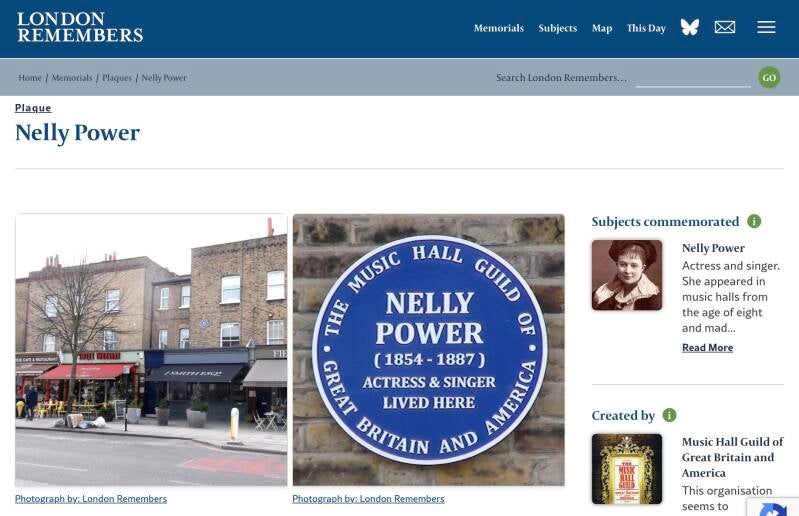
Southgate Grove


Nearby
“CHAMPAGNE CHARLIE”

East Canonbury Conservation Area
Elmore Rd.
Essex Rd.
Ashby Grove
Arran Walk
THE MARQUESS TAVERN P.H.

Cannonbury St.
Willow Bridge
The course of the NEW RIVER, now path and gardens… and the watchman hut

From London Gardens Online: "The water that runs through New River Walk is actually formed by ponds landscaped to resemble the former river. It had first been planted as a garden by the New River Company in the 1860s and ownership was then transferred in 1951 to Islington Borough Council, for whom it was one of a number of open spaces planned as post WWII improvements. Re-landscaped in 1952, the gardens were re-opened on 29 May 1954 by Herbert Morrison MP."
Create Your Own Website With Webador